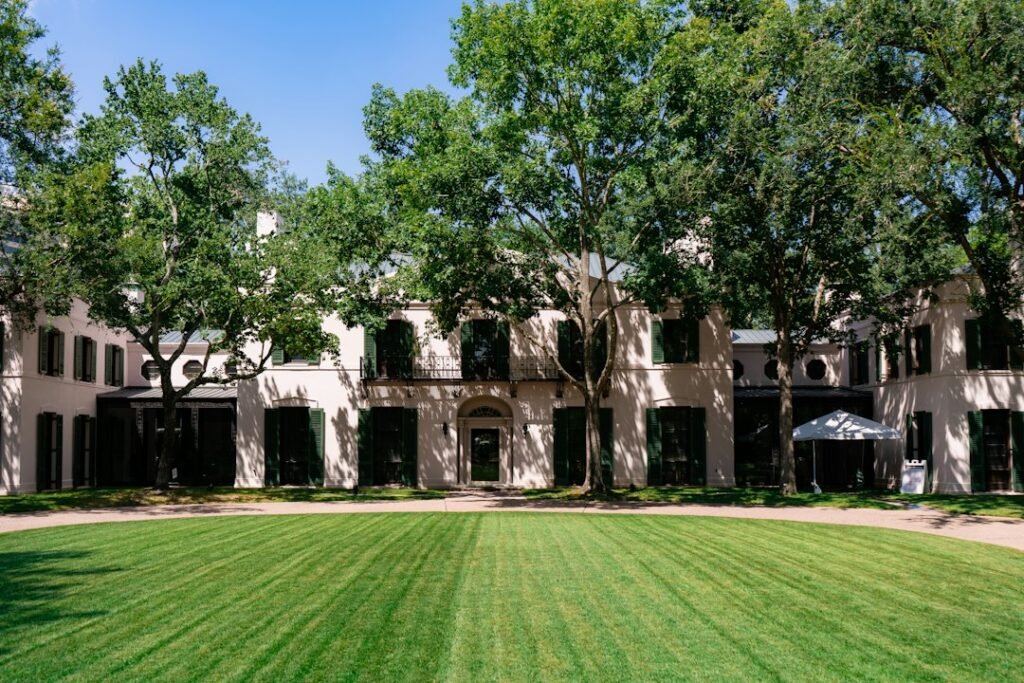
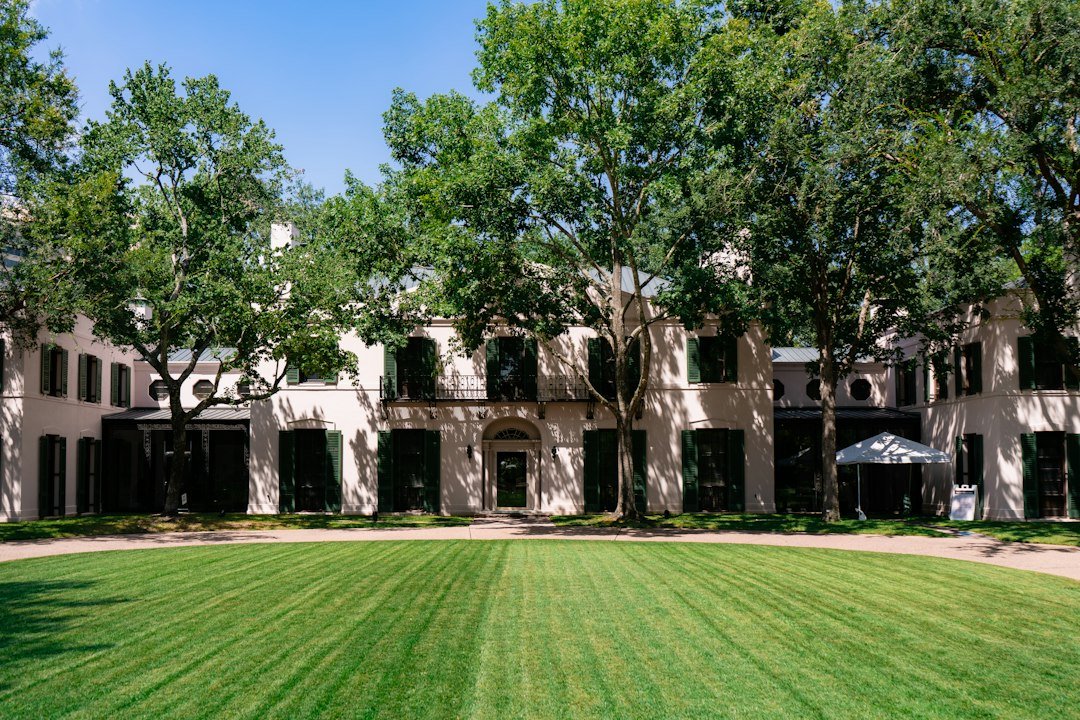
St. Augustine grass can turn yellow in shady areas when the turf receives too little light, stays wet too long, develops weak roots, or faces higher disease pressure. St. Augustine is shade tolerant relative to many warm-season grasses, but “shade tolerant” does not mean it thrives in deep shade.
Low light reduces turf density
Grass uses light to produce the carbohydrates that support leaves, stolons, and roots. In heavy shade, St. Augustine may become thinner, grow more slowly, and lose color.
The turf may also stretch upward with longer, softer leaves and wider spacing between shoots.
Shady soil dries more slowly
Full-sun and shaded areas often should not receive the same irrigation treatment. Shade lowers evaporation and can keep the soil wet longer.
If the yellow area stays damp while nearby sunny turf dries normally, reduce unnecessary irrigation before assuming a nutrient deficiency.
Disease pressure can increase
UF/IFAS notes that shaded turf can experience greater disease pressure because humidity is higher, air movement is lower, and leaf wetness lasts longer.
Yellowing in shade may therefore involve both weak growth and disease stress.
Tree roots compete for resources
Under mature trees, grass competes with roots for water and nutrients. The area can be shaded and dry at the same time, especially near large surface roots.
Check soil moisture before deciding whether the shade zone is too wet or too dry.
Do not push shade turf with extra nitrogen
Heavy nitrogen does not create more sunlight. Excess fertility can produce soft growth that is harder to maintain and may increase disease pressure.
Raise mowing height rather than scalping
Keeping more leaf area helps shaded turf capture available light. Avoid cutting St. Augustine short in an attempt to “clean up” thin areas.
How to tell shade stress from a nutrient problem
Shade stress usually follows the light pattern: turf weakens under the canopy and improves toward brighter edges. A whole-lawn nutrient issue is less likely to stop at the shade line.
What to check first
- Estimate how much direct light reaches the turf.
- Check soil moisture.
- Review irrigation runtime for the shaded zone.
- Inspect leaves for disease symptoms.
- Check roots near trees.
- Avoid excessive fertility.
If the problem is more brown than yellow, see St. Augustine turning brown under trees once that guide is published. For yellowing generally, use the yellow St. Augustine guide.
Additional diagnostic clues
How much shade is too much?
There is no single hourly sunlight number that applies to every St. Augustine cultivar and site. Dense canopy, filtered light, tree species, season, and building shade all change the amount and quality of light reaching the turf.
Use the lawn itself as evidence: turf that repeatedly thins and yellows only in the darkest zone may be below its sustainable light level.
Reduce irrigation before increasing fertilizer
Because shaded soil often dries more slowly, reducing excess irrigation can be more useful than pushing more growth with nitrogen. A wet shaded lawn may face both weak growth and disease pressure.
Tree pruning is not always the answer
Canopy thinning may increase light where appropriate, but tree health and safety come first. Avoid removing major limbs solely to support turf without considering the tree’s structure.
Consider a non-turf solution when the site is too dark
If reasonable mowing, irrigation, and fertility cannot maintain dense St. Augustine, a mulched bed or shade-adapted ground cover may provide a more durable landscape than repeatedly replacing sod.
Notice whether the problem changes by season
A shade zone may perform reasonably in spring when sun angles are different, then thin as the tree canopy fills in. Seasonal changes in light can explain why the same area seems healthy for part of the year and weak later.
Keep fallen leaves from smothering the turf
Leaf litter can further reduce light and trap moisture. Remove heavy accumulations without aggressively raking or tearing up St. Augustine stolons.
Use mowing frequency, not just height, to reduce stress
Shaded grass grows more slowly. Mow when needed rather than on a rigid schedule that repeatedly removes minimal growth or creates unnecessary traffic on soft soil.