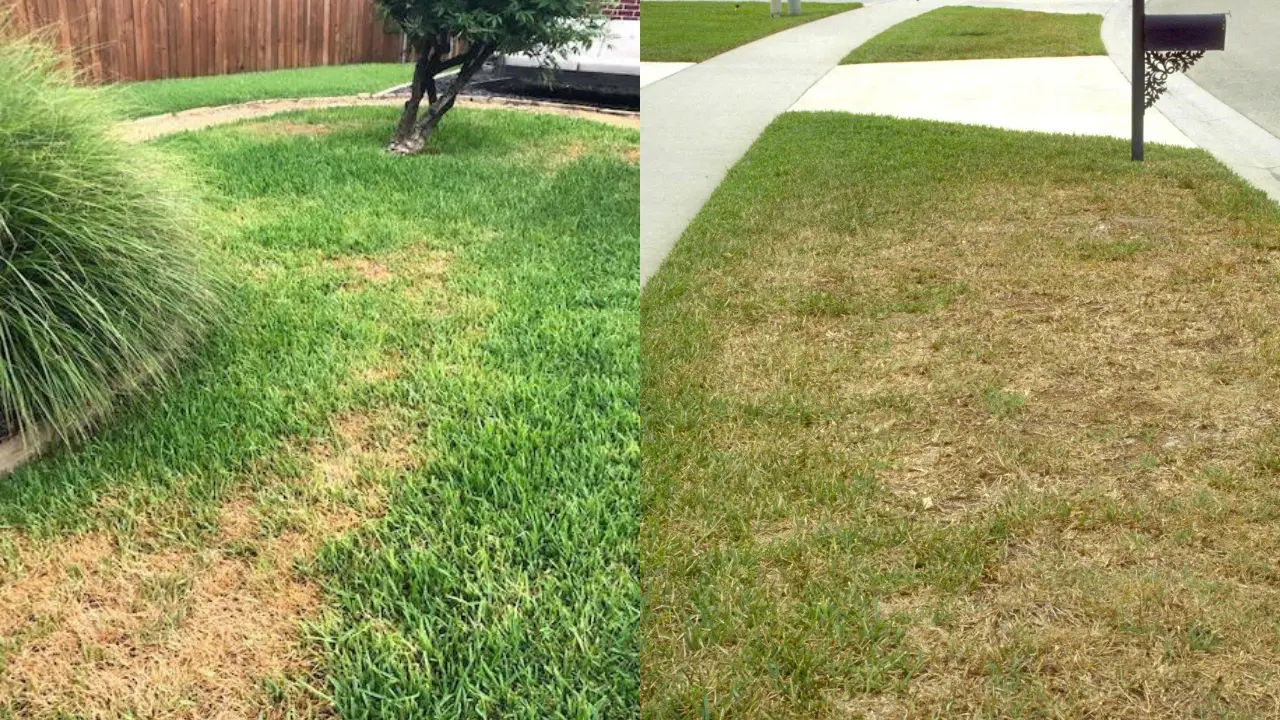
The shape of a brown patch in St. Augustine grass can help narrow the cause, but it cannot identify the problem by itself. Irregular expanding patches can fit chinch bugs or drought stress, rounded patches can suggest disease, and sharp geometric patterns often point toward irrigation, fertilizer, or chemical injury.
Irregular patches
Irregular damage is common with several problems. Chinch bugs, drought stress, root disease, and uneven irrigation can all produce patches that do not form neat circles.
Use the edge of the patch for the next step. Is the soil dry? Are chinch bugs present? Are roots weak? Is the turf yellowing before it dies?
Circular or semicircular patches
Large patch disease often forms circular or semicircular areas in warm-season turf. The disease is most associated with cooler, moist conditions rather than peak summer heat.
Look for a defined yellowing margin and inspect leaf tissue at the edge. Patch shape is a clue, not a final diagnosis.
Brown areas beside sidewalks and driveways
These locations receive extra reflected heat and can dry faster. They are also common chinch bug trouble spots.
Check both explanations: soil moisture and sprinkler coverage first, then inspect the transition zone for chinch bugs if the damage continues.
Brown strips or arcs
Damage that follows a sprinkler pattern often points toward irrigation coverage. A dry strip between heads or an arc-shaped dead zone can be more informative than the grass color itself.
Run the irrigation system and compare water distribution before treating for insects or disease.
Brown spots in low areas
Low spots may stay wet longer after irrigation or rain. Constant saturation can weaken roots and create conditions that favor disease.
If the soil remains wet and the turf is yellowing before turning brown, drainage deserves attention.
Brown patches under trees
Under trees, St. Augustine can face shade, root competition, uneven moisture, and longer leaf wetness.
A thin brown area beneath a dense canopy may have a very different cause from a hot sunny patch beside concrete.
Brown patches after mowing
If a patch appears immediately after mowing and follows high or low spots in the yard, scalping may be involved. Dull mower blades can also leave a brown cast across the lawn.
Inspect the leaf tips. Ragged, shredded cuts support a mowing explanation.
Brown patches after fertilizer or weed control
Straight edges, stripes, overlap marks, or spray shapes can point toward application injury.
Do not add more product until you review what was applied, where, and at what rate.
Brown patches that lift easily
If the turf peels or lifts because roots are missing or badly damaged, inspect for root problems such as grubs or root disease.
Chinch bug damage usually does not remove the root system in the same way.
Brown patches with a yellow edge
A yellow transition zone means the problem is active, but several causes can create it. Chinch bugs, disease, and advancing water stress can all produce a yellow-to-brown progression.
Sample the active edge instead of the dead center.
How to document the pattern
Take one wide photo showing the entire patch and a second close photo of the edge. Mark the boundary with a small flag or note a fixed reference point.
Recheck in several days. An expanding patch suggests an active process; a stable patch may represent old damage.
A pattern-based diagnostic sequence
- Describe the shape.
- Note the location.
- Check soil moisture.
- Inspect sprinkler coverage.
- Check roots and stolons.
- Inspect for chinch bugs when appropriate.
- Review season and recent lawn treatments.
For the broader starting point, see why St. Augustine grass turns brown. For insect-specific irregular damage, use the chinch bug guide.
Additional diagnostic clues
What the patch edge can reveal
The middle of a brown patch mostly shows what has already happened. The edge shows what is happening now. Fresh yellowing, wilt, active insects, soft leaf tissue, or moist soil at the boundary can be more diagnostic than completely dead grass in the center.
When comparing several patches, inspect the same relative location on each one. If every active edge looks similar, one cause may be driving the pattern. If the edges differ, the lawn may have more than one problem.
Why a photo taken from above helps
A standing-height or second-story photo can reveal patterns that disappear when you are kneeling in the grass. Irrigation arcs, mower paths, circular disease patterns, and heat-stressed edges are often easier to recognize from a wider view.