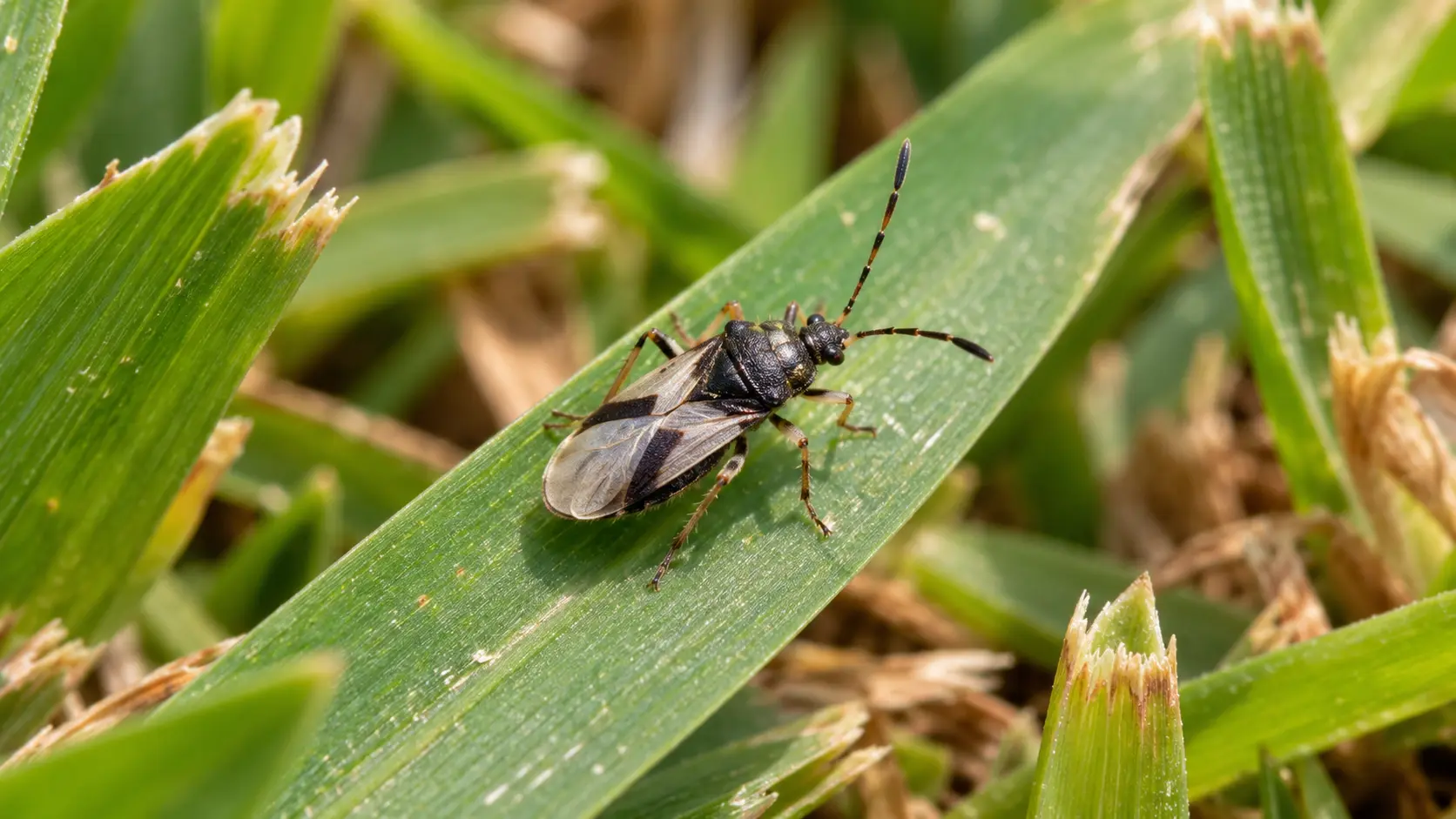
Chinch bugs are small, sap-feeding insects that live in turf and can cause serious damage when populations build up. In southern lawns, the species of greatest concern is the southern chinch bug, especially in St. Augustine grass. Adults are dark with pale wings, while young nymphs begin orange-red and darken as they mature.
The most important identification rule is simple: do not diagnose chinch bugs from a brown lawn alone. The insect itself, its life stage, its location in the turf, and the pattern of damage all matter.
What is a chinch bug?
Chinch bugs are true bugs in the genus Blissus. They feed with piercing-sucking mouthparts, drawing plant fluids from grass stems and stolons. Texas A&M identifies the southern chinch bug as an important pest of St. Augustine grass, particularly during hot, dry weather.
Several chinch bug species occur in North America, and their preferred grasses vary by region. For Dallas-area St. Augustine lawns, southern chinch bug identification is the most useful reference point.
What does an adult chinch bug look like?
Adult southern chinch bugs are very small—about 3/16 inch long according to Texas A&M. Their most recognizable features are:
- A dark or black body.
- Pale to white wings folded flat over the back.
- Dark triangular markings on the wings.
- A narrow, compact body that moves quickly through stems and thatch.
Some adults have fully developed wings while others have shorter wings. Their size makes them easy to overlook unless you get close to the grass.
What do young chinch bugs look like?
Young chinch bugs are called nymphs. They do not look exactly like the adults. Texas A&M describes early nymphs as orange-pink with a pale band across the abdomen. As they grow, they become darker and begin developing wing pads.
A simplified progression is:
- Small orange or reddish nymph.
- Pale band visible across the abdomen.
- Body darkens through later nymph stages.
- Wing pads become more noticeable.
- Mature adult develops the familiar pale wings and dark body.
For a closer look at the immature stages, see the separate guide on identifying chinch bug nymphs.
Where should you look for chinch bugs?
Chinch bugs are usually easier to find near the base of the grass than on top of the lawn. Extension sources describe them in stems, crowns, thatch, and the upper organic layer near the soil surface.
If a lawn has suspicious damage, inspect the transition zone where green turf meets yellowing or recently damaged grass. The center of a completely dead patch is often a poor place to search because active insects may already have moved toward living turf.
Sunny, hot areas deserve extra attention. In St. Augustine, damage is frequently noticed near driveways, sidewalks, curbs, and other heat-reflecting surfaces during hot weather.
How do chinch bugs damage grass?
Both nymphs and adults feed on plant fluids. When populations are high, affected St. Augustine can become yellow, wilted, brown, and eventually dead. The damage is usually irregular rather than perfectly circular because the insects are distributed unevenly through the lawn.
As feeding continues, damaged patches can enlarge and merge. This progression is one reason chinch bug injury can be mistaken for drought stress.
For a damage-focused visual guide, see what chinch bug damage looks like in St. Augustine grass.
Chinch bugs vs. beneficial big-eyed bugs
One of the most important lookalikes is the big-eyed bug. Big-eyed bugs are predators and can help reduce pest populations, so mistaking them for chinch bugs can lead to unnecessary insecticide use.
The easiest field clue is the head: big-eyed bugs have conspicuously large eyes and a broader head. Adult chinch bugs have a narrower appearance and distinctive pale wings with dark markings.
If the insect does not clearly match a chinch bug, do not treat merely because it is small and moving through the lawn.
How to know whether the insects are actually causing the lawn problem
Finding one chinch bug does not automatically prove that chinch bugs caused every brown spot. A useful diagnosis combines several pieces of evidence:
- The turf is a susceptible grass, especially St. Augustine.
- The damage pattern is irregular and expanding.
- The problem is active in hot, sunny turf.
- Chinch bugs are found in the damaged-but-not-dead transition zone.
- Other causes such as irrigation gaps, disease, and root damage have been considered.
Texas A&M recommends monitoring with methods such as visual inspection and a flotation test. A confirmed population is much stronger evidence than color alone.
How to inspect a lawn for chinch bugs
Start with a hands-and-knees inspection before reaching for any product.
- Find the edge where healthy grass changes to yellow or brown turf.
- Part the grass with your fingers.
- Look around stems, crowns, thatch, and the soil surface.
- Watch for fast-moving adults and reddish or orange nymphs.
- Repeat the inspection in several places.
If visual inspection is inconclusive, a water-filled open-ended can can be used as a flotation test. The dedicated chinch bug testing guide.
What chinch bug identification does not tell you
Identification answers “what insect is this?” It does not automatically answer “should I treat?” Treatment decisions depend on active damage, population level, turf condition, and the current label for any pesticide being considered.
It also does not tell you whether every brown area in the lawn has the same cause. Irrigation coverage, disease, root problems, and other pests can occur alongside chinch bugs.
Dallas and Texas context
Texas A&M describes southern chinch bugs as important pests of St. Augustine grass during hot, dry conditions. That makes chinch bug identification especially relevant for North Texas homeowners managing warm-season turf through summer stress.
Use the local context as a reason to inspect—not as proof. A Dallas lawn can turn brown for many reasons, and the insects still need to be confirmed.
Key takeaway
Adult chinch bugs are tiny, dark insects with pale wings and dark markings. Young nymphs begin orange-red with a pale abdominal band and darken as they mature. Look for them at the base of St. Augustine grass, especially along the active edge of irregular damage.
If you are dealing with brown or yellow St. Augustine, the broader Dallas guide to chinch bugs in St. Augustine grass explains how identification, damage, drought stress, testing, and treatment decisions fit together.