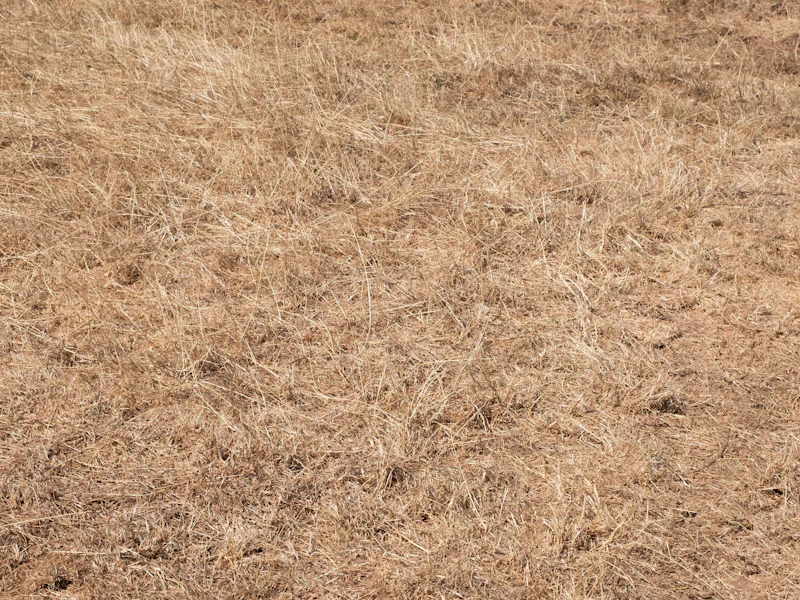
If St. Augustine stays brown after watering, the problem may not be drought—or the turf may already be dead. Poor roots, chinch bugs, disease, chemical injury, uneven irrigation, and old damage can all remain brown even when the soil receives water.
One watering does not prove anything
Severely drought-stressed turf does not necessarily turn green overnight. Recovery depends on how much living tissue remains.
At the same time, repeatedly watering a lawn that has another problem can create waterlogging and disease pressure.
Check whether the soil actually got wet
Water may be running off, missing the patch, or wetting only the surface.
Probe several inches into the soil after irrigation. Compare the brown area with green turf nearby.
The grass may already be dead
Dead stolons and crowns cannot recover from irrigation. Pull back the canopy and inspect the runners.
If they are dry and brittle with no living nodes, the question is no longer how much to water but whether the area needs repair after the cause is corrected.
Root damage can make wet soil look like drought
A lawn can wilt in moist soil when roots are too damaged to supply the leaves.
Take-all root rot, severe compaction, chronic saturation, and root-feeding pests can all create this mismatch.
Chinch bugs can mimic water stress
Chinch bug damage often looks like a lawn that needs water. The difference is that watering does not remove the insects.
Inspect the active edge for adults and nymphs rather than assuming more water is the answer.
Disease can continue despite watering
Some St. Augustine diseases are favored by excess moisture. If the soil is already wet and the patch continues to decline, more irrigation may make conditions worse.
Uneven sprinkler coverage can fool you
A controller may run for 20 minutes while the damaged area receives almost nothing because of blocked heads or poor overlap.
A catch-can test helps show how much water actually reaches the turf.
Old brown tissue can remain after the cause is fixed
If drought, chinch bugs, or another stress already killed leaves, those leaves stay brown. New growth from living nodes is the sign to watch.
Do not judge recovery only by old blades.
Fertilizer and herbicide injury do not wash away instantly
Chemical injury can remain visible after irrigation. Water may help reduce some residues when the product label calls for it, but damaged tissue still needs time to recover.
What to check before watering again
- Probe the soil.
- Run the sprinkler zone and watch coverage.
- Check stolons for life.
- Inspect roots.
- Look for chinch bugs.
- Review disease symptoms and recent lawn applications.
When recovery is likely
If stolons are alive, roots are functioning, and the stress is corrected during active growth, St. Augustine can recover gradually.
Completely dead areas need surrounding turf to spread in or may require plugs or sod.
For broader troubleshooting, see why St. Augustine turns brown. If you are unsure whether the grass is alive, use dead, dormant, or stressed?
Additional diagnostic clues
Separate “water reached the lawn” from “roots can use it”
Moist soil only proves water is present. Roots that are diseased, oxygen-starved, shallow, or severely damaged may not be able to supply the leaves effectively. This is why adding more water to already moist soil can worsen the situation.
Check the irrigation depth, not only the surface
The top half-inch can look wet while deeper soil remains dry. Probe several inches down and compare multiple points. Conversely, a wet surface over saturated subsoil can reveal poor drainage.
When to shift from watering to repair
If stolons are dead, the damage edge is stable, and the original cause has been corrected, continued irrigation will not regenerate dead crowns. At that point, recovery depends on neighboring runners filling the area or on plugs or sod.