If St. Augustine grass is dying in patches, first determine whether the affected turf is actually dead, then check soil moisture, roots, insects, disease patterns, and recent lawn treatments. Patchy decline often has a local cause, so replacing sod before solving that cause can lead to the same failure again.
Step 1: Confirm whether the grass is dead
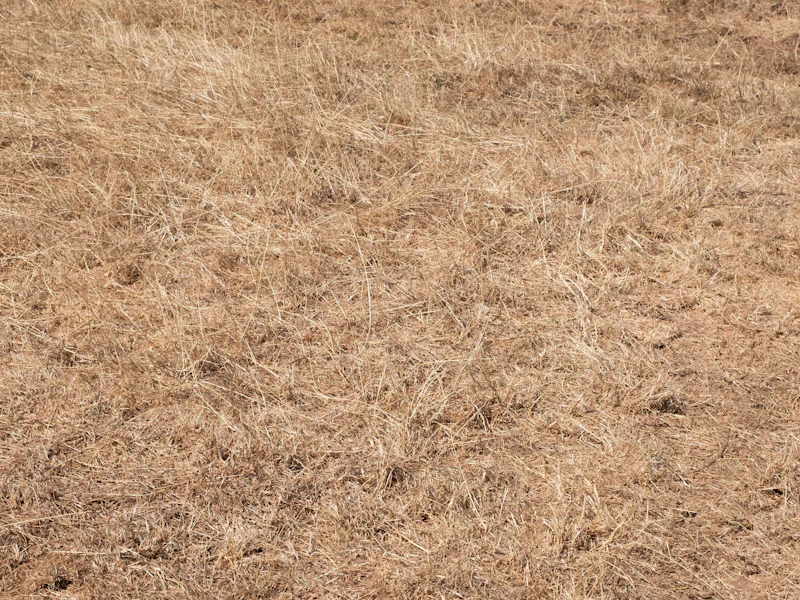
Brown leaves can remain attached to living stolons. Pull back the leaf canopy and inspect the runners.
Living St. Augustine may still have green tissue at nodes or firm stolons. Dead stolons are dry, brittle, and show no viable growing points.
Step 2: Check soil moisture in and outside the patch
Compare the damaged patch with healthy turf nearby. If the damaged area is much drier, uneven irrigation or runoff may be responsible.
If the area is saturated while nearby turf has drained, poor drainage or excessive irrigation may be stressing roots.
Step 3: Inspect the roots
Weak or missing roots are a major clue. Take-all root rot can produce short, dark, rotten roots. White grubs can feed on roots and cause turf to loosen from the soil.
A patch that lifts easily deserves a below-ground diagnosis.
Step 4: Inspect the active edge for chinch bugs
Hot, sunny irregular patches in St. Augustine are classic places to check for chinch bugs. Look at damaged-but-not-dead turf around the perimeter rather than the fully dead center.
If insects are found, confirm the species and population before treating.
Step 5: Consider turf disease
Large patch, take-all root rot, and gray leaf spot can all damage St. Augustine. Season and tissue symptoms help separate them.
Large patch is associated with cooler, moist periods. Take-all root rot involves the roots. Gray leaf spot affects leaves and can worsen under humid, wet conditions.
Step 6: Review mowing
Scalping can create localized damage where the ground is uneven. If the mower cuts one area much lower than the rest, St. Augustine may lose too much leaf tissue and expose stolons.
Dull blades can also make turf look brown and frayed.
Step 7: Review recent products
Did the damage appear after fertilizer, herbicide, or another lawn application?
Look for straight lines, overlaps, spray edges, or damage that matches where the product was applied.
When patchy death points toward a site problem
Some areas repeatedly fail because of:
- Deep shade.
- Tree-root competition.
- Compacted soil.
- Standing water.
- Runoff on slopes.
- Heat reflected from pavement.
If the same patch dies every year, fix the site limitation before reinstalling turf.
Should you replace the sod now?
Not until the active problem is identified and stable. New sod needs the same basic conditions as the original lawn.
Replacement makes sense when the existing stolons are dead and the site can support St. Augustine once the original stress is corrected.
A fast triage checklist
- Is the patch truly dead?
- Is the soil too dry or too wet?
- Are roots healthy?
- Are chinch bugs present?
- Does disease timing fit?
- Was the area recently scalped, fertilized, or sprayed?
- Does the location have a recurring site limitation?
If you are still at the broad diagnosis stage, start with why St. Augustine grass turns brown. If the pattern itself is the main clue, use the brown-patch pattern guide.
Additional diagnostic clues
How fast the patches are changing matters
A patch that doubles in size within days needs a different response from an old dead spot that has looked the same for a month. Mark the boundary with a small flag or use a fixed object in a photo so you can see whether the damage is still moving.
Fast expansion raises the priority of active causes such as pests, severe drought, disease, or ongoing chemical exposure. A stable patch shifts attention toward recovery and repair.
Do not diagnose every patch as the same problem
Large yards can have a dry sprinkler gap on one side and root disease in another. Sample more than one damaged area before deciding that a single treatment belongs everywhere.
This is especially important before pesticide use, because insecticides and fungicides do not correct irrigation, compaction, or dead roots.