
Brown or yellow St. Augustine in a Dallas lawn can look like a simple watering problem, but summer heat creates another possibility: chinch bugs. The difficulty is that drought stress and chinch bug damage can appear at the same time and often affect the same hot, sunny areas.
The safest approach is not to guess from color alone. Compare the pattern, check the soil and irrigation, inspect the transition zone, and look for the insects themselves before treating.
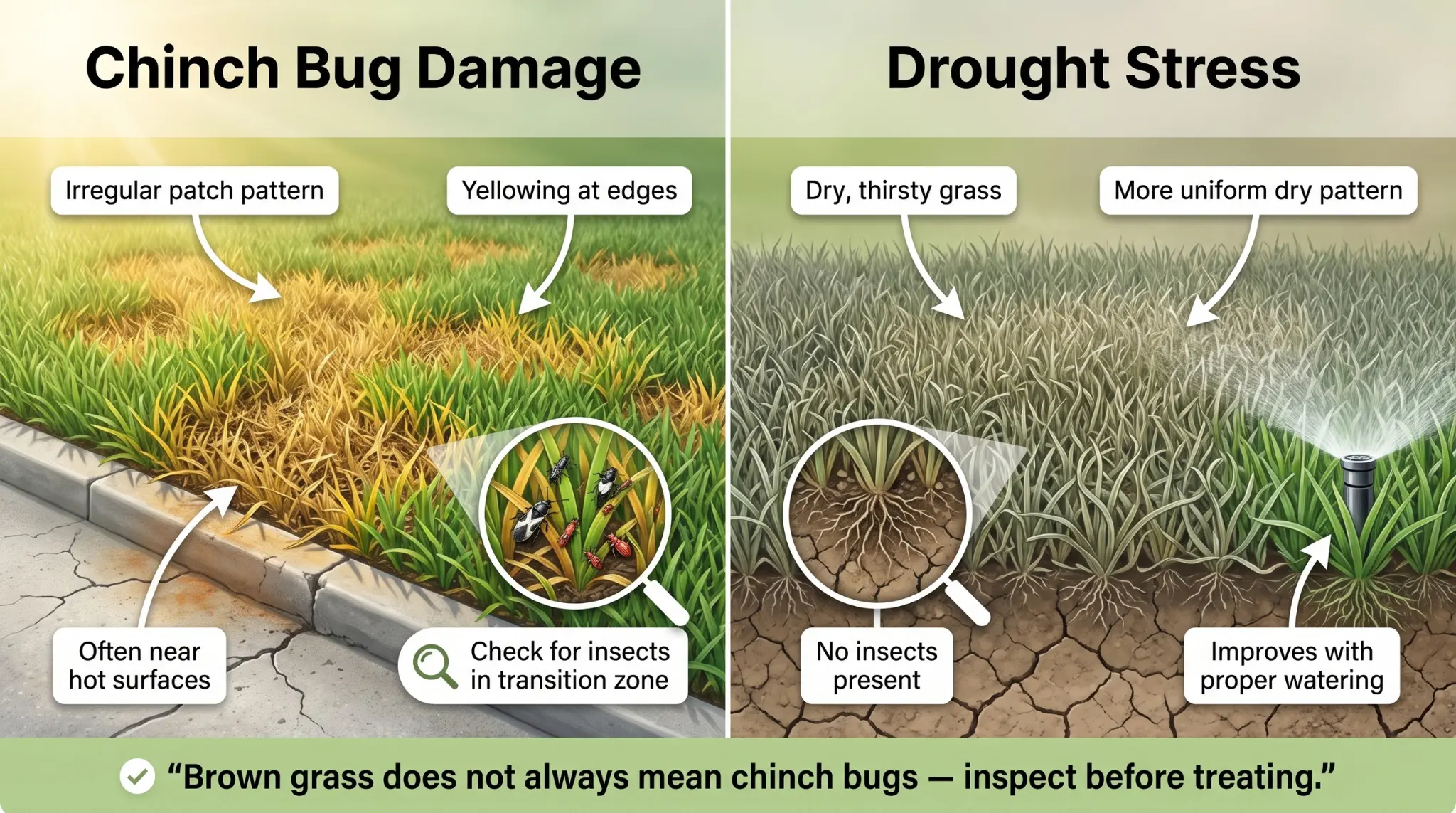
Quick answer: chinch bugs vs drought stress
Drought stress is more likely when the soil is dry, the turf shows wilt or a dull bluish-gray color, and the damaged pattern follows weak sprinkler coverage, exposed slopes, or broad dry areas.
Chinch bugs become more likely when irregular patches expand through hot, sunny St. Augustine, especially near pavement, and active insects can be found at the edge between healthy and declining turf.
Neither clue is enough by itself. Texas A&M AgriLife Extension emphasizes confirming significant numbers of chinch bugs before treating, while also checking irrigation and other causes of turf decline.
Why these two problems are easy to confuse in Dallas
Dallas summers create exactly the conditions that make diagnosis difficult. St. Augustine can become drought-stressed during prolonged heat, and southern chinch bugs also perform well in hot, dry conditions. A lawn can therefore be short on water and have an active chinch bug population at the same time.
That overlap is why adding more water is not a reliable chinch bug test. If the turf has already been injured by insects, irrigation alone will not restore the damaged tissue. At the same time, a dry lawn may improve after effective irrigation even though no insects are present.
Chinch bugs vs drought: the main clues
| Clue | More consistent with chinch bugs | More consistent with drought stress |
|---|---|---|
| Pattern | Irregular expanding patches | Broad dry areas or patterns that follow irrigation gaps |
| Location | Hot, sunny St. Augustine, often near sidewalks or driveways | Any area receiving inadequate moisture, including slopes or missed sprinkler zones |
| Soil moisture | May be dry or adequately moist | Usually dry in the active root zone |
| Turf response to water | Damaged areas may continue declining | Wilted turf may improve when the moisture deficit is corrected |
| Insects | Chinch bugs present at the transition zone | No damaging chinch bug population found |
| Best confirmation | Inspect turf closely or perform a flotation test | Check soil moisture and sprinkler distribution |
Clue 1: look at the shape of the damaged area
Chinch bug damage commonly starts as irregular areas of stressed or dying turf and can spread outward as the insects move toward living grass. Dallas County Master Gardeners notes that chinch bugs often show up in the hottest, sunniest portions of a lawn, particularly near sidewalks and driveways.
Drought stress can also create irregular areas, especially when soil depth, roots, slope, shade, or sprinkler coverage varies across a property. That is why pattern is useful, but not definitive.
Clue 2: check whether the pattern follows the irrigation system
Run the sprinklers and watch what actually happens rather than assuming every zone covers the lawn evenly.
Look for:
- heads that are blocked by turf or landscaping;
- misaligned spray patterns;
- poor overlap between heads;
- water landing on pavement instead of grass;
- areas on slopes where water runs off quickly;
- sunny edges that dry much faster than the center of the lawn.
If the damaged strip closely matches a weak irrigation area and the soil is dry, water stress moves higher on the list.
Clue 3: check the soil, not only the grass blades
Grass color alone can be misleading. Push a screwdriver or soil probe into several locations and compare the moisture below the surface. Check both the damaged area and a nearby healthy area.
Texas A&M describes drought-stressed St. Augustine as showing clues such as curled leaf edges, a dull bluish-gray appearance, or turf that does not spring back quickly after being walked on.
If the root zone is already moist and the affected area continues to expand, simply running the irrigation system longer is unlikely to solve the problem.
Clue 4: inspect the transition zone for chinch bugs
Do not start in the middle of a completely dead patch. If chinch bugs caused the injury, many insects may already have moved toward healthier grass.
Instead, inspect the border where green turf changes to yellow, wilted, or recently damaged grass.
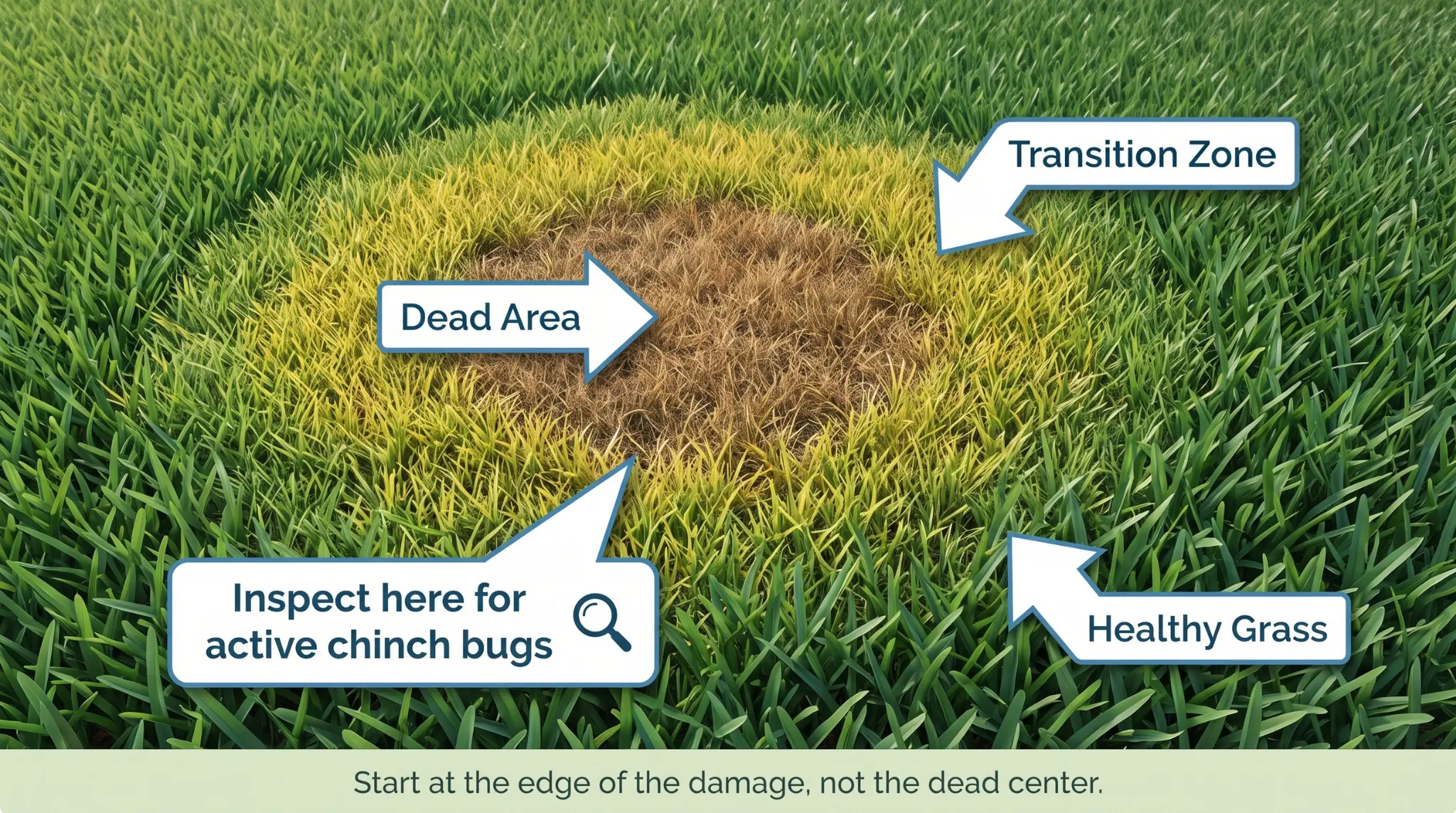
Part the grass with your fingers and look near the lower stems, thatch, and soil surface. Adult southern chinch bugs are tiny and dark with pale wings, while younger nymphs can appear reddish or orange before becoming darker.
If one location shows nothing, inspect several parts of the active edge.
Clue 5: use a flotation test when visual inspection is difficult
A flotation test can make small chinch bugs easier to detect. Texas A&M describes using an open-ended metal can pushed into the turf and filled with water so insects rise toward the surface.
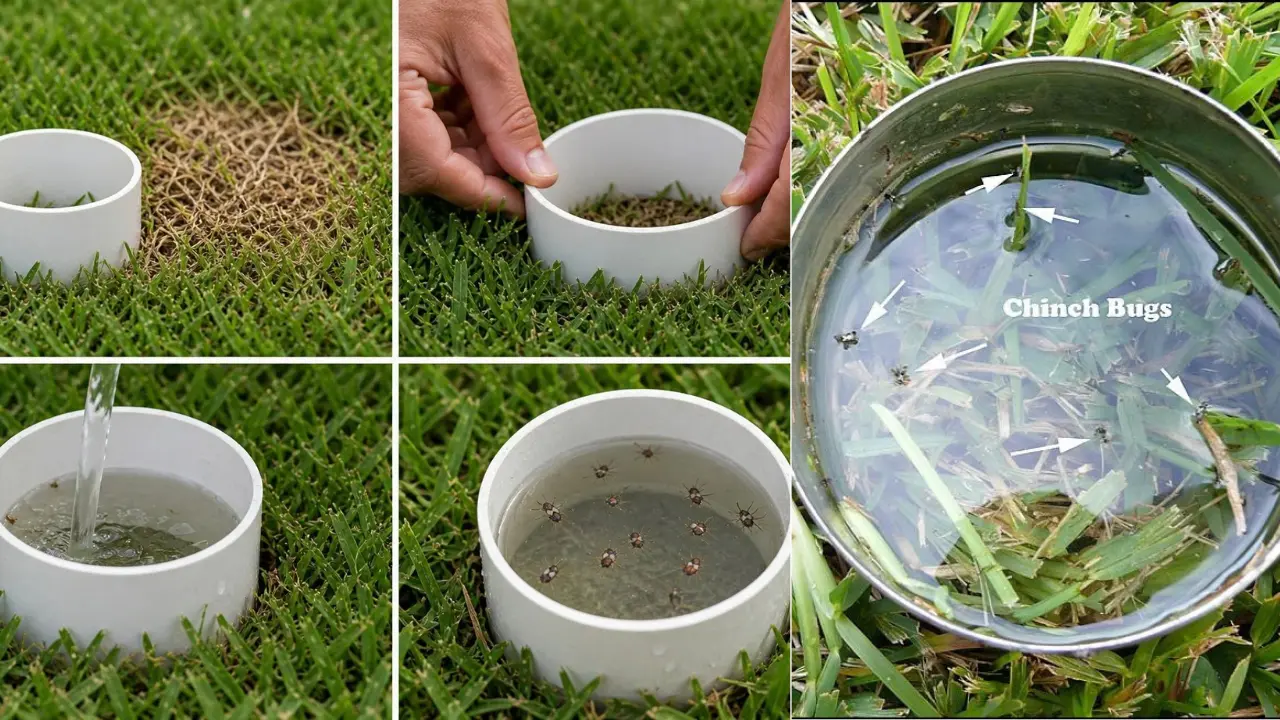
- Choose turf at the edge of the damaged area rather than the completely dead center.
- Push an open-ended metal can several inches into the turf and soil.
- Fill the can with water and keep the water level up for roughly 10 minutes.
- Watch the surface for insects that float upward.
- Repeat the test in several locations if needed.
Texas A&M notes that damage is commonly associated with roughly 20 to 25 chinch bugs per square foot. With a six-inch-diameter flotation can, an average of about four to five or more chinch bugs per sample can indicate damaging numbers.
What if watering does not improve the lawn?
A lawn failing to recover after watering does not automatically prove chinch bugs. Several other problems can reduce the turf’s ability to respond to irrigation.
Take-all root rot
Root disease can leave St. Augustine weak, yellow, and easy to pull from the soil. Texas A&M notes that infected roots may be short, dark, and rotten, which also makes the lawn more vulnerable to drought stress.
Large patch
Large patch can produce yellow or brown areas, often with a more circular or semicircular pattern. Season matters because large patch is more strongly associated with cooler, wetter conditions than the classic hot-summer chinch bug pattern.
White grubs or other root injury
Root-feeding pests can cause turf to loosen from the soil. If the grass lifts easily and roots are badly damaged, inspect below the turf rather than assuming the problem is drought or chinch bugs.
Shade and root competition
St. Augustine tolerates shade better than many warm-season grasses, but dense shade still reduces vigor. Tree roots can also compete for moisture, so a thin area beneath a tree can remain stressed even when the irrigation system is working.
A practical five-minute diagnosis
- Look at the pattern. Is it irregular, expanding, and concentrated in a hot sunny edge?
- Check the sprinkler system. Does the damaged area match a dry zone or missed spray pattern?
- Check soil moisture. Compare the affected area with healthy turf.
- Inspect the transition zone. Look closely for chinch bugs among stems and thatch.
- Confirm before treating. Use a flotation test or repeat the inspection in several locations.
If the evidence points toward insects, read our detailed chinch bug identification guide and our Dallas chinch bug guide before choosing a treatment.
What to do if the problem is drought stress
Correct the moisture problem rather than automatically increasing the watering frequency everywhere.
- Repair or reposition malfunctioning sprinkler heads.
- Improve overlap between irrigation zones.
- Water deeply enough to reach the active root zone.
- Allow the soil to dry appropriately between irrigation events.
- Adjust for rainfall instead of following a fixed schedule regardless of weather.
- Check current local watering restrictions before changing the schedule.
For seasonal timing, see the St. Augustine grass care calendar for Dallas.
What to do if chinch bugs are confirmed
Texas A&M recommends confirming that treatment is actually needed before using an insecticide. When a population is limited to one area, spot treatment may reduce unnecessary pesticide use and lessen the impact on beneficial insects.
If you use a pesticide, the current product label controls where, when, and how it can be applied. Avoid relying on old application rates or instructions copied from another product.
After treatment, continue checking the active edge rather than judging success only by the color of turf that is already dead.
Can drought stress make chinch bug damage worse?
Yes. Texas A&M notes that drought-stressed lawns are more susceptible to chinch bug injury and that hot, dry conditions favor the insects. That means the two problems can reinforce each other.
This is another reason to avoid treating them as mutually exclusive. A Dallas lawn can need an irrigation correction and pest management at the same time.
Common mistakes Dallas homeowners should avoid
- Do not diagnose from a brown patch alone. Several lawn problems look similar.
- Do not keep increasing water when the soil is already wet. Overwatering can create additional root and disease problems.
- Do not spray an insecticide without confirming insects. Treatment may be unnecessary and can affect beneficial organisms.
- Do not inspect only dead turf. Check the transition zone where living grass is beginning to decline.
- Do not assume one problem explains the entire yard. Different sections can have different causes.
Frequently asked questions
Do chinch bugs always appear near concrete?
No. Hot sunny areas near sidewalks and driveways are common trouble spots, but chinch bugs can occur elsewhere in St. Augustine. The location is a clue, not proof.
Can drought stress and chinch bugs happen together?
Yes. Hot, dry conditions can stress St. Augustine and also favor chinch bug activity. Inspect the lawn for both moisture problems and insects.
Will watering kill chinch bugs?
No. Correct watering can reduce drought stress, but irrigation is not a reliable chinch bug control. Confirm the insects and follow current extension and product-label guidance if treatment is necessary.
Why is my St. Augustine brown even though the soil is wet?
Possible causes include chinch bug injury, root disease, excessive moisture, poor drainage, other pests, or damage that occurred before the soil was rewatered. Check roots, insects, and the pattern before adding more water.
What is the strongest evidence of chinch bugs?
Finding a significant number of chinch bugs in the actively declining portion of the lawn is stronger evidence than the appearance of the brown patch alone.
Sources and further reading
- Texas A&M AgriLife Extension: Chinch Bugs in St. Augustine Lawns
- Texas A&M AgriLife Extension: St. Augustinegrass Lawn Management
- Dallas County Master Gardeners: Chinch Bugs in St. Augustine Lawns
This article is informational and does not replace an in-person lawn diagnosis or a pesticide label. If a pesticide is used, follow the current label for the exact product.