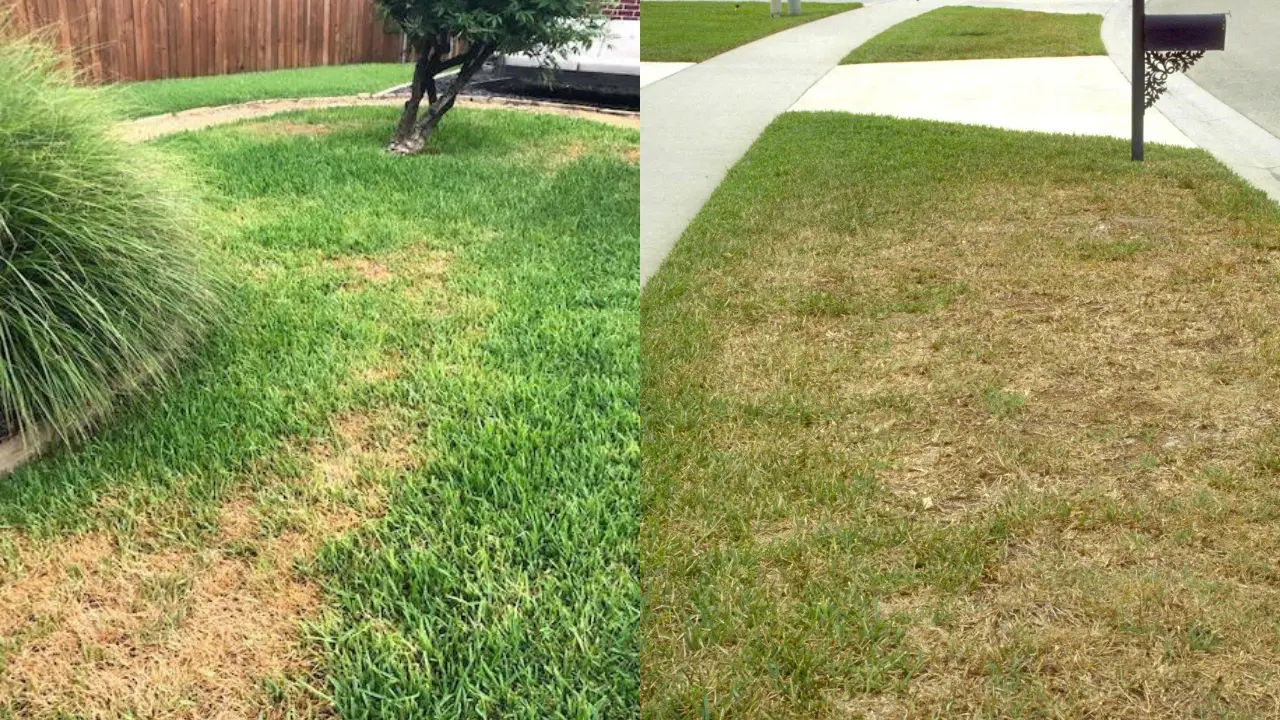
Yes. Severe chinch bug feeding can kill St. Augustine grass. Texas A&M describes heavily damaged turf turning yellow and dying, with irregular patches expanding and merging as chinch bug numbers increase.
However, brown grass is not automatically dead, and chinch bugs are not the only cause of dead St. Augustine. Confirm the pest before deciding what happened.
How chinch bug feeding injures St. Augustine
Nymphs and adults use piercing-sucking mouthparts to remove fluids from stems and stolons. Texas A&M also describes saliva being injected during feeding.
When populations are high—especially during extended dry weather—the combined stress can cause plant tissue to yellow, wilt, brown, and die.
What severe damage looks like
A severe infestation can produce:
- Large irregular brown areas.
- Yellowing at the active edge.
- Multiple patches merging together.
- Dead centers with continuing decline around the outside.
Texas A&M notes that extensive damage can eventually involve much of a lawn.
How to tell whether the grass is dead or only stressed
Look below the brown leaf blades.
Stressed but living St. Augustine may still have:
- Green tissue near the crown.
- Firm stolons.
- Living nodes capable of producing new growth.
- Roots that remain attached and functional.
Completely dead turf lacks viable growing points and will not simply turn green again when chinch bugs are controlled.
Why watering is not a death test
A dead patch will not recover from watering, but neither will every stressed lawn green immediately after one irrigation cycle.
Use soil moisture, plant tissue, insect presence, and the damage pattern together.
Can a small infestation kill an entire lawn?
Chinch bugs are unevenly distributed and damage often begins in localized spots. If populations increase and spread through susceptible St. Augustine, those areas can enlarge and merge.
Early scouting reduces the chance that a small problem becomes a large repair project.
Does finding chinch bugs prove they killed the grass?
No. A few chinch bugs can be present without being the main cause of a brown area.
Confirm that:
- The insects are correctly identified.
- They are concentrated near active damage.
- The population is meaningful.
- The damage pattern fits.
- Other causes do not explain the symptoms better.
What else can kill St. Augustine?
Texas A&M identifies several problems that can create severe decline, including:
- Take-all root rot.
- Large patch.
- White grubs.
- Drought or irrigation failure.
- Other environmental stress.
That is why the diagnosis should be made before pesticide treatment or sod replacement.
What happens after the insects are controlled?
Living turf can recover or spread into thin areas during active growth. Dead areas may require plugs or sod.
Do not judge treatment by whether old brown grass turns green. Judge it by whether chinch bug activity and new damage stop.
Can St. Augustine come back on its own?
Yes, if enough living stolons remain and growing conditions are favorable. St. Augustine spreads vegetatively and can fill smaller gaps.
Larger completely dead areas take longer and may be better repaired directly.
When repair makes sense
After confirming control, inspect the size of the dead area, the amount of living surrounding turf, irrigation, soil, sunlight, and roots.
The repair guide explains the choice between natural fill-in, plugs, and sod.
How to reduce the chance of severe damage next time
- Scout previous trouble spots during hot weather.
- Fix irrigation gaps.
- Avoid excessive nitrogen and thatch.
- Mow appropriately.
- Confirm insects early with direct inspection or a flotation test.
Key takeaway
Chinch bugs can kill St. Augustine grass when damaging populations continue feeding, but the presence of brown grass does not prove that happened. Confirm the pest, determine what tissue is still alive, and repair only after active injury has stopped.
Can chinch bugs kill only part of a lawn?
Yes. Chinch bug populations are often clumped, so one sunny section can be severely damaged while another remains healthy. A localized dead area does not mean the entire property is headed toward the same outcome.
How fast can severe damage develop?
Extension sources describe damage developing rapidly during hot, dry conditions when populations are high. The practical response is early scouting rather than trying to predict an exact number of days.
What should you photograph before deciding the grass is dead?
Take close images of stolons and crowns as well as a wider photo of the patch. This creates a record of whether green tissue remains and whether the boundary is still expanding.
Do not remove dead turf until the cause is understood
Removing a patch too early can erase diagnostic evidence and disturb surviving runners. Confirm pest control, inspect roots and irrigation, then decide what needs to be replaced.