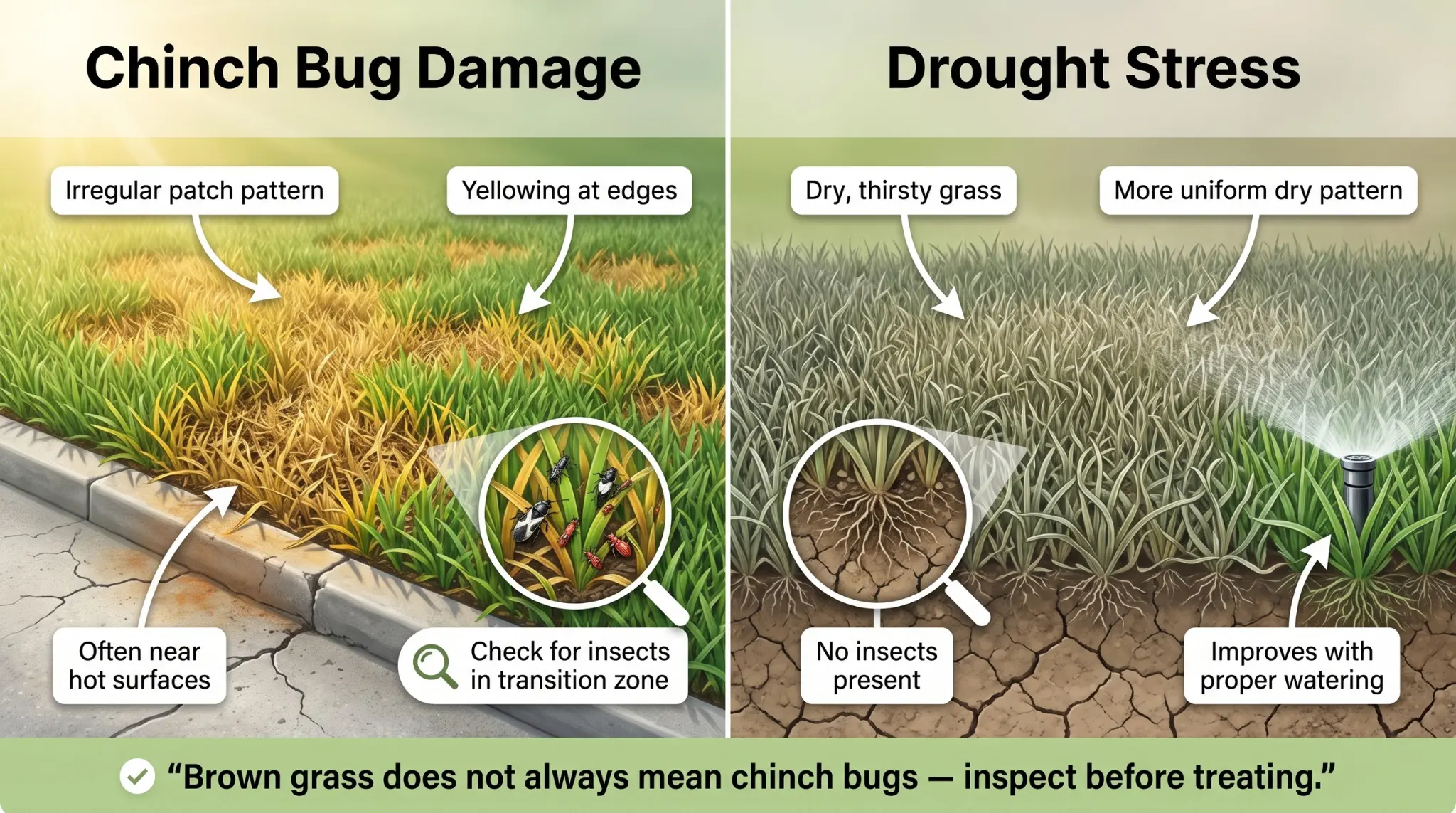
Your brown lawn may not have chinch bugs if repeated scouting finds no insects, the pattern matches irrigation failure, roots are badly damaged, or the symptoms fit a turf disease better. Chinch bugs are an important St. Augustine pest, but treating every brown patch as an infestation is a diagnostic mistake.
Sign 1: You cannot find chinch bugs where they should be
Check the transition zone between healthy and damaged turf, not just the dead center. Part the grass and use a flotation test in several locations.
If repeated checks reveal no adults or nymphs, the chinch bug explanation becomes weaker.
Sign 2: The brown pattern matches sprinkler coverage
A dry strip, corner, or arc that lines up with missing irrigation is strong evidence of water stress.
Run the system and watch for blocked heads, poor overlap, overspray, and pressure problems.
Sign 3: The soil is dry throughout the root zone
Hot St. Augustine can wilt and brown simply because the roots cannot access enough moisture.
Soil moisture should be checked before adding an insecticide to a drought-stressed lawn.
Sign 4: The damage is circular during cool, moist weather
Texas A&M describes large patch as a disease that often develops in circular or semicircular areas during cooler, moist conditions in spring and fall.
That pattern is different from the irregular hot-weather injury typically associated with chinch bugs.
Sign 5: Leaf blades pull away at the edge of the patch
Large patch can weaken the attachment of affected leaf blades to stolons. If leaves separate easily from the plant in a characteristic disease pattern, investigate large patch rather than assuming insects.
Sign 6: Roots are short, black, or rotten
Texas A&M describes take-all root rot as a root disease that can produce yellowing and irregular dead patches. Damaged roots become dark and weak, and stolons can lift more easily from the soil.
That root symptom points away from a simple chinch bug diagnosis.
Sign 7: The turf lifts like loose carpet
Root-feeding white grubs can remove enough roots that turf loses anchorage. If a damaged area rolls back easily, inspect the soil for grubs.
Chinch bugs feed around stems and stolons rather than chewing off the root system in that way.
Sign 8: The problem is mainly in deep shade
Chinch bug injury is most often associated with sunny, hot turf. A weak St. Augustine lawn in deep shade may be struggling with insufficient light or other shade-related stress.
Shade does not make chinch bugs impossible, but it makes other explanations worth investigating.
Sign 9: The lawn is brown because it is dormant
Warm-season St. Augustine naturally loses green color during cold weather in North Texas. Winter dormancy should not be confused with a hot-weather chinch bug outbreak.
Look at season, temperature, and whether the entire lawn is entering dormancy rather than developing an irregular active patch.
Sign 10: Damage continues even when chinch bug numbers fall
If a confirmed infestation is controlled but decline continues elsewhere, another stress may also be present.
Recheck water, roots, disease symptoms, and site conditions before applying more insecticide.
A better brown-lawn diagnostic sequence
- Map the damage pattern.
- Check soil moisture.
- Run the irrigation system.
- Inspect the active edge for chinch bugs.
- Look at roots and stolons.
- Compare symptoms with large patch and take-all root rot.
- Use the season and site conditions as supporting context.
Why “no bugs found” must be based on proper sampling
One quick look is not enough because chinch bugs are clumped. Sample several points in damaged-but-not-dead turf.
The testing guide explains the correct sampling location and flotation method.
Related comparisons
If water stress is the leading alternative, use chinch bugs vs. drought. If disease is more likely, see chinch bugs vs. lawn fungus.
Key takeaway
Brown St. Augustine is a symptom, not a diagnosis. The absence of chinch bugs, an irrigation-shaped pattern, diseased roots, seasonal disease clues, or root-feeding pests can all point toward another cause.
Sign 11: the damage appeared immediately after another lawn event
If browning follows herbicide exposure, fertilizer burn, construction traffic, soil disturbance, or irrigation failure, that timing may provide a stronger explanation than chinch bugs. Look for a pattern that matches the event.
Sign 12: the problem affects areas chinch bugs do not explain well
Uniform decline across both sunny and shaded turf, or symptoms extending into plants and landscape beds, may point toward a broader water, chemical, or environmental issue.
Keep “possible” separate from “confirmed”
Chinch bugs can remain on the list of possibilities without being the working diagnosis. A useful homeowner investigation narrows causes as evidence accumulates rather than jumping from one guess to another.
When to stop DIY diagnosis
If the lawn continues declining after irrigation, insect, root, and disease checks, a local extension office or qualified diagnostic service may be more efficient than trying multiple treatments. Bring photos, a timeline, and a sample from the boundary between healthy and affected turf.