
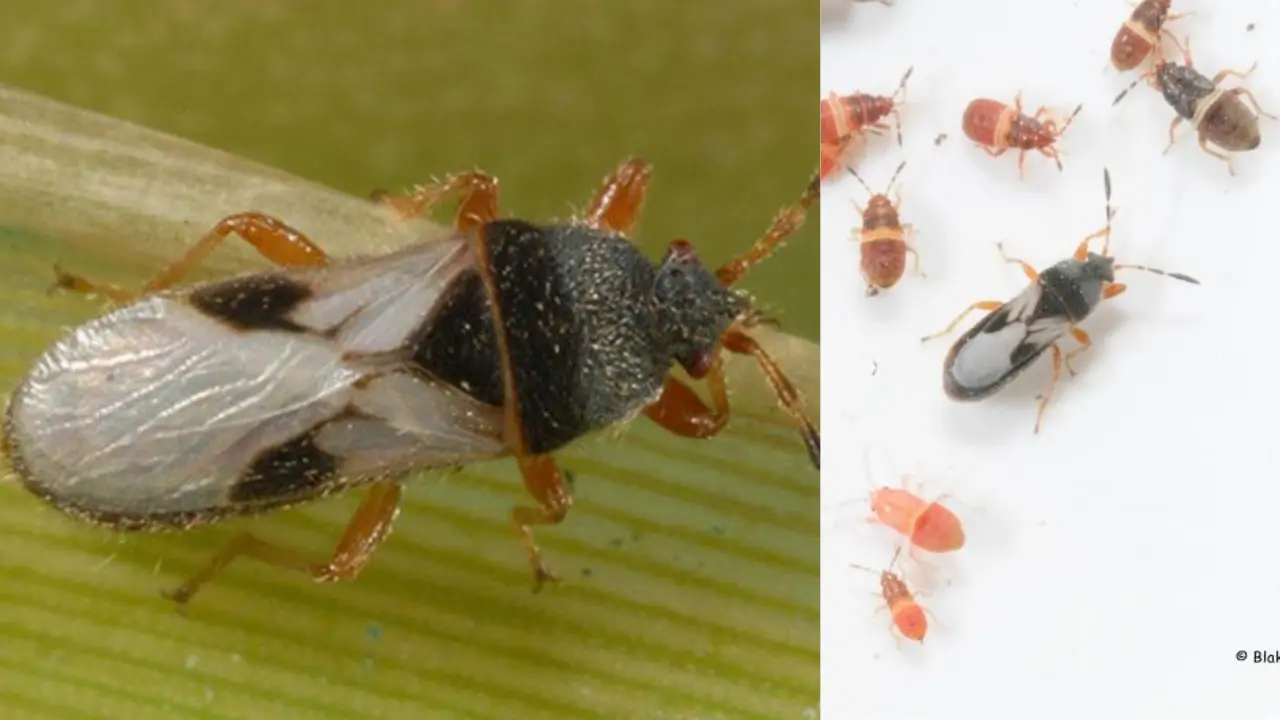
Adult southern chinch bugs are tiny dark insects with pale or white wings marked by dark triangular patches. Young chinch bugs, called nymphs, start orange-red with a light band across the abdomen and become darker as they mature.
Because chinch bugs are only a fraction of an inch long, accurate identification usually requires getting down into the turf and looking closely at the insect—not simply judging the lawn from a standing position.
Adult chinch bug appearance
Texas A&M describes adult southern chinch bugs as about 3/16 inch long. Their key field marks include:
- A black or very dark body.
- Pale, frosty-white, or bone-white wings folded over the back.
- A dark triangular marking on each wing.
- Six legs and a narrow, oval body.
- Either long wings or short wings, depending on the individual.
The pale wings against the dark body are the feature most homeowners notice once they are close enough to see the insect clearly.
How small are chinch bugs?
Adults are roughly one-fifth of an inch or less. Nymphs are smaller. That scale matters because debris, seeds, tiny beneficial insects, and moving bits of thatch can all be mistaken for pests when viewed quickly.
A phone camera with close focus or a simple hand lens can make the markings easier to see, but the insect’s behavior and location in the lawn are also useful clues.
What do chinch bug nymphs look like?
Nymphs are wingless immature chinch bugs. Early nymphs are much brighter than adults. Texas A&M describes the smallest stages as orange-pink with a whitish band across the abdomen just behind the thorax.
As nymphs grow:
- The orange-red color becomes darker.
- The pale band becomes less visually dominant.
- Wing pads begin to develop.
- Later nymphs become dark brown to nearly black.
This color change explains why a group of chinch bugs can contain insects that do not all look alike.
Do chinch bugs have larvae?
No. Chinch bugs develop through gradual metamorphosis: egg, nymph stages, then adult. The immature moving stages are called nymphs, not larvae.
That terminology is useful when comparing chinch bugs with pests such as white grubs, which are beetle larvae and look completely different.
What do chinch bug eggs look like?
Chinch bug eggs are extremely small and are not the practical target for most homeowner diagnosis. Extension identification resources focus much more on nymphs and adults because those stages can be found moving through stems and thatch.
For a homeowner trying to diagnose active lawn damage, finding nymphs and adults in the transition zone is more useful than searching for eggs.
What does a chinch bug look like when it is moving?
Chinch bugs can move quickly through the lower turf when disturbed. You may see them scurrying around the base of grass stems or across exposed soil after parting the turf.
In a heavy population, adults and nymphs may be easier to notice because several life stages can occur together during warm weather.
Chinch bug vs. big-eyed bug
The beneficial big-eyed bug is one of the most important chinch bug lookalikes. Big-eyed bugs prey on other insects, including chinch bugs, and should not be targeted simply because they are found in the same lawn.
| Feature | Chinch bug | Big-eyed bug |
|---|---|---|
| Eyes | Relatively small | Large and conspicuous |
| Head | Narrower | Broader |
| Adult wings | Pale with dark triangular markings | Different gray-brown pattern |
| Role in lawn | Turf-feeding pest | Beneficial predator |
If you are unsure, avoid treating until the insect has been identified more confidently.
Where appearance and lawn symptoms meet
A correct insect ID becomes more meaningful when it matches the lawn pattern. Chinch bug injury in St. Augustine commonly appears as irregular yellowing and browning, especially in hot, sunny areas.
Still, damage alone is not an identification feature. Drought stress, irrigation gaps, large patch, take-all root rot, and other problems can produce similar turf symptoms.
Where to look for the insect
The best place to inspect is usually not the center of dead grass. Look along the edge where green turf changes to yellow or recently damaged turf.
- Part the grass at the transition zone.
- Look around stems and crowns.
- Check the thatch and upper soil surface.
- Watch for both pale-winged adults and reddish nymphs.
- Repeat in several locations.
If the insects are too hard to spot visually, a flotation test can bring them to the surface.
What homeowners commonly misidentify
Several things can cause confusion:
- Big-eyed bugs: beneficial predators with large eyes.
- Small beetles or debris: dark material in thatch can appear insect-like until examined closely.
- White grubs: C-shaped larvae found in soil around roots, not tiny adults in stems.
- Other true bugs: color alone is not enough for identification.
Use multiple features rather than one color or one photograph.
A quick chinch bug ID checklist
An adult is more likely to be a southern chinch bug if it is:
- Very small, around 3/16 inch.
- Dark-bodied.
- Pale-winged with dark triangular markings.
- Found low in turf or thatch.
- Present near active St. Augustine damage.
A nymph is more likely to be a chinch bug if it is tiny, orange-red or darkening with age, has a pale abdominal band in earlier stages, and is found in the same turf habitat.
What to do after identifying the insect
Identification is the first step, not an automatic treatment instruction. The next question is whether the insects are present in numbers associated with active damage.
Use the general chinch bug identification guide for context, and the St. Augustine chinch bug guide for the broader diagnosis.