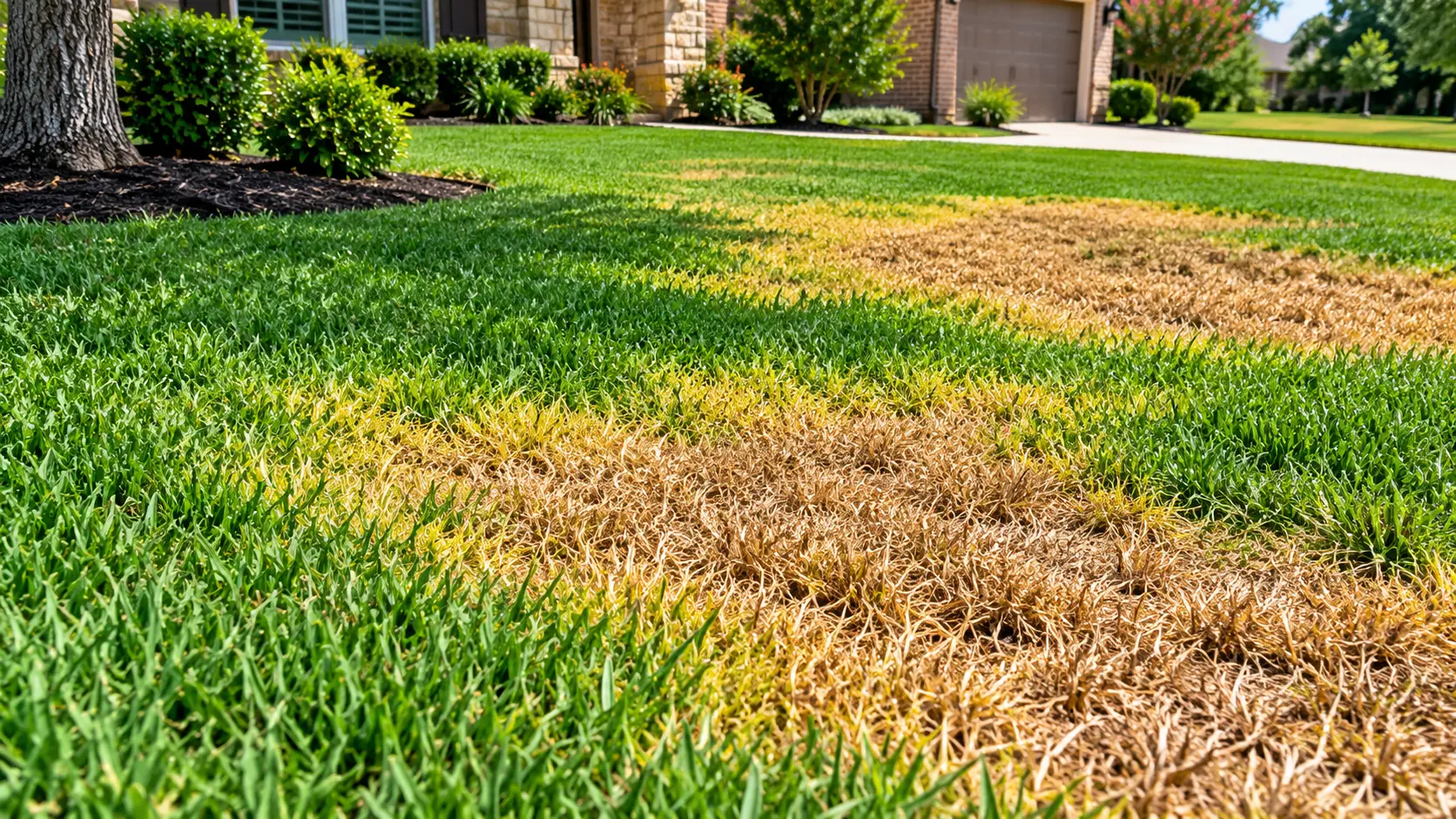
Chinch bug damage in St. Augustine grass usually appears as irregular patches of yellowing, stunted, or dying turf that expand outward during hot weather. The damaged areas often show up in sunny parts of the lawn, especially near sidewalks, driveways, curbs, patios, and other heat-reflecting surfaces.
But appearance alone is not enough to confirm chinch bugs. Drought stress, uneven sprinkler coverage, turf disease, root problems, and other pests can create similar brown or yellow areas. For Dallas homeowners, the most useful approach is to recognize the pattern, inspect the active edge of the damage, and then look for the insects themselves.
The classic chinch bug damage pattern
Texas A&M AgriLife describes the first clue as expanding, irregular patches of dead or stunted grass surrounded by yellowing, dying turf. As the infestation grows, small damaged areas can enlarge and merge into larger sections of declining St. Augustine.
The pattern is often easier to recognize when you look at the whole lawn rather than one brown spot. Typical clues include:
- Irregular patches instead of neat circles.
- Yellow or wilted grass around the edge of a brown area.
- Damage that appears to be spreading into previously green turf.
- More severe injury in hot, sunny parts of the yard.
- Damage near pavement or other surfaces that add heat.
Dallas County Master Gardeners notes that chinch bugs are commonly found in the sunniest parts of St. Augustine lawns and often near hot sidewalks or driveways. Locally, visible damage is most associated with the hot part of the growing season.
What color does chinch bug damage turn?
Chinch bug injury usually does not jump directly from healthy green turf to completely dead grass. The grass can move through several stages as feeding continues.
You may see:
- Dull or stressed-looking green turf. The area may initially look thirsty.
- Yellowing or straw-colored blades. The active edge of the patch can look yellow or faded.
- Brown, declining turf. As injury becomes more severe, blades wilt and die.
- Dead areas that continue expanding. If insects remain active, the patch can spread into nearby healthy St. Augustine.
NC State Extension similarly describes St. Augustine affected by southern chinch bugs as turning yellow and then brown or whitish as damage progresses.
Where chinch bug damage is most likely to appear
Location is an important clue. Southern chinch bugs thrive in warm conditions, and Texas A&M notes that damage develops rapidly in sunny locations during hot, dry weather.
In a Dallas lawn, inspect these areas first:
- Full-sun sections of St. Augustine.
- Grass bordering sidewalks and driveways.
- Turf next to curbs, patios, masonry, or other hot surfaces.
- Areas that had confirmed chinch bugs in a previous season.
- Stressed areas that continue declining despite reasonable irrigation coverage.
That does not mean every dry strip next to a driveway is caused by insects. Pavement also increases heat and water stress, so the same locations can suffer from drought or poor irrigation coverage.
What does the edge of chinch bug damage look like?
The transition zone is often more useful than the middle of the dead patch. This is the border where healthy green turf changes into yellow, wilted, or recently damaged grass.
Why does that matter? When grass in the center is already dead, active chinch bugs may have moved outward to continue feeding on living turf. Texas A&M and other extension guidance recommend looking for the insects around the edge of damaged areas.
At the active edge, look for:
- Green grass changing to yellow or bronze.
- Stunted blades mixed with healthier turf.
- Small black-and-white adult chinch bugs near the base of the grass.
- Smaller orange, pinkish, or reddish nymphs.
If you suspect the pest, part the grass and inspect the stems, thatch, and soil surface in several locations rather than relying on one quick check.
Chinch bug damage vs. drought stress
This is the most common source of confusion. Chinch bug damage and drought stress both become obvious during hot weather, and both can produce yellow or brown St. Augustine.
| Clue | Chinch bug damage | Drought or irrigation stress |
|---|---|---|
| Shape | Often irregular and expanding | May follow sprinkler gaps, dry edges, slopes, or broad exposed areas |
| Location | Often sunny hot spots, especially near pavement | Anywhere the soil or roots are not receiving enough usable moisture |
| Patch edge | Yellowing or dying transition zone may be visible | Can fade more broadly or follow irrigation patterns |
| Strongest evidence | Actual chinch bugs found in the active edge | Dry soil or uneven irrigation with no significant chinch bug population |
Watering response can provide another clue, but it is not a perfect test. Dallas County Master Gardeners notes that turf damaged by chinch bugs may appear water-stressed but does not recover simply because more water is applied.
A separate comparison guide can examine chinch bugs vs. drought in more detail.
Chinch bug damage vs. large patch
Large patch can also cause St. Augustine to turn yellow and brown, but the pattern is usually different.
Texas A&M notes that brown patch/large patch symptoms tend to appear in circular or semicircular patterns, while chinch bug injury is more often irregular. Season is another clue. Dallas County Master Gardeners describes large patch as a cooler-season turf problem compared with the hot-weather pattern associated with chinch bugs.
If the lawn shows rounded patches with blades that pull easily from the runners, disease may deserve more attention than chinch bugs.
Chinch bug damage vs. grub damage
Grubs feed below the surface and injure roots, so the turf can lose its connection to the soil. Dallas County Master Gardeners notes that irregular dying turf that lacks roots and lifts easily can point toward grubs rather than chinch bugs.
A chinch bug problem is more likely to show active insects in the stems and thatch around the damaged edge rather than root loss beneath the patch.
Does chinch bug damage always start brown?
No. One reason homeowners miss early chinch bug damage is that the first signs can look like ordinary summer stress.
The grass may initially appear:
- Slightly wilted.
- Dull green.
- Yellowing around the edge.
- Stunted compared with nearby healthy turf.
By the time the center of a patch is completely brown, the infestation may have been active for some time. Checking suspicious yellow or declining areas before they become fully dead gives you a better chance of finding insects in the transition zone.
What do chinch bugs themselves look like?
Adult southern chinch bugs are small black insects with pale or white wings and dark markings. Texas A&M lists adults at roughly 3/16 inch long. Younger nymphs are smaller and can appear orange-pink or reddish with a pale band across the abdomen before becoming darker as they mature.
They can be difficult to see without getting close to the turf. Their small size is another reason a lawn should not be diagnosed from a standing-height visual inspection alone.
Beneficial big-eyed bugs can also be mistaken for chinch bugs. Identification matters because big-eyed bugs prey on lawn pests rather than damaging the turf.
How to confirm that the damage is really from chinch bugs
The visual pattern should tell you where to investigate, not automatically what to treat.
Texas A&M says detecting significant numbers of the insects is the best proof of chinch bug damage. Two practical methods are:
Part the turf
Get down at the edge of the damaged area, spread the blades apart, and inspect the stems, thatch, and soil surface. Repeat this in several places around the patch.
Use a flotation test
Push an open-ended metal can into damaged-but-not-dead turf, fill it with water, and keep the water level up long enough for insects to float to the surface. Testing several locations gives a better picture than one sample.
For step-by-step instructions and diagnostic thresholds, read our full Dallas guide to chinch bugs in St. Augustine grass.
When the pattern should make you question a chinch bug diagnosis
Pause before assuming chinch bugs if:
- The damage is strongly circular or ring-shaped.
- The lawn problem began mainly in cool spring weather.
- The turf lifts easily because roots are gone.
- The damaged area clearly matches poor sprinkler coverage.
- The soil is dry throughout the root zone and no chinch bugs are found.
- The area is heavily shaded rather than hot and sunny.
These clues do not automatically identify another problem, but they should widen the diagnosis before any pesticide is considered.
A simple visual checklist for Dallas homeowners
If you are looking at a suspicious patch of St. Augustine, ask these questions in order:
- Is the patch irregular rather than neatly circular?
- Is there yellowing or declining turf around the edge?
- Is the area in full sun or close to pavement?
- Is the patch expanding into healthy grass?
- Have you checked sprinkler coverage and soil moisture?
- Can you find actual chinch bugs in the transition zone?
The more of these clues that line up, the stronger the case for chinch bugs. The final question matters most: finding the insects is better evidence than the color or shape of the patch.
Common questions about chinch bug damage
Can chinch bug damage look like a lawn that needs water?
Yes. Chinch bug injury can resemble drought stress, especially during hot Dallas summers. Check soil moisture and irrigation coverage, then inspect the edge of the damaged turf for insects.
Does chinch bug damage happen in the shade?
It can occur wherever susceptible turf and insects are present, but extension sources consistently describe the most severe or noticeable damage in sunny, hot areas.
Can chinch bug damage spread across the lawn?
Yes. Texas A&M describes damaged patches increasing in size and merging as insect numbers rise.
Will watering turn chinch bug-damaged grass green again?
Water can help drought-stressed turf, but watering alone does not remove an active chinch bug population. Severely damaged or dead turf may not recover even after the insects are controlled.
Is every brown patch in St. Augustine a chinch bug problem?
No. Drought, irrigation problems, large patch, take-all root rot, grubs, mowing stress, and other conditions can cause brown or declining St. Augustine. Confirm the cause before treating.
Sources and further reading
- Texas A&M AgriLife Extension: Chinch Bugs in St. Augustine Lawns
- Texas A&M Landscape IPM: Chinch Bugs
- Dallas County Master Gardeners: Chinch Bugs in St. Augustine Lawns
- NC State Extension: Chinch Bugs in Turf
This article is informational. Lawn symptoms can overlap, and a visual pattern alone does not confirm a pest. If a pesticide is used, follow the current product label for the specific site and target pest.