
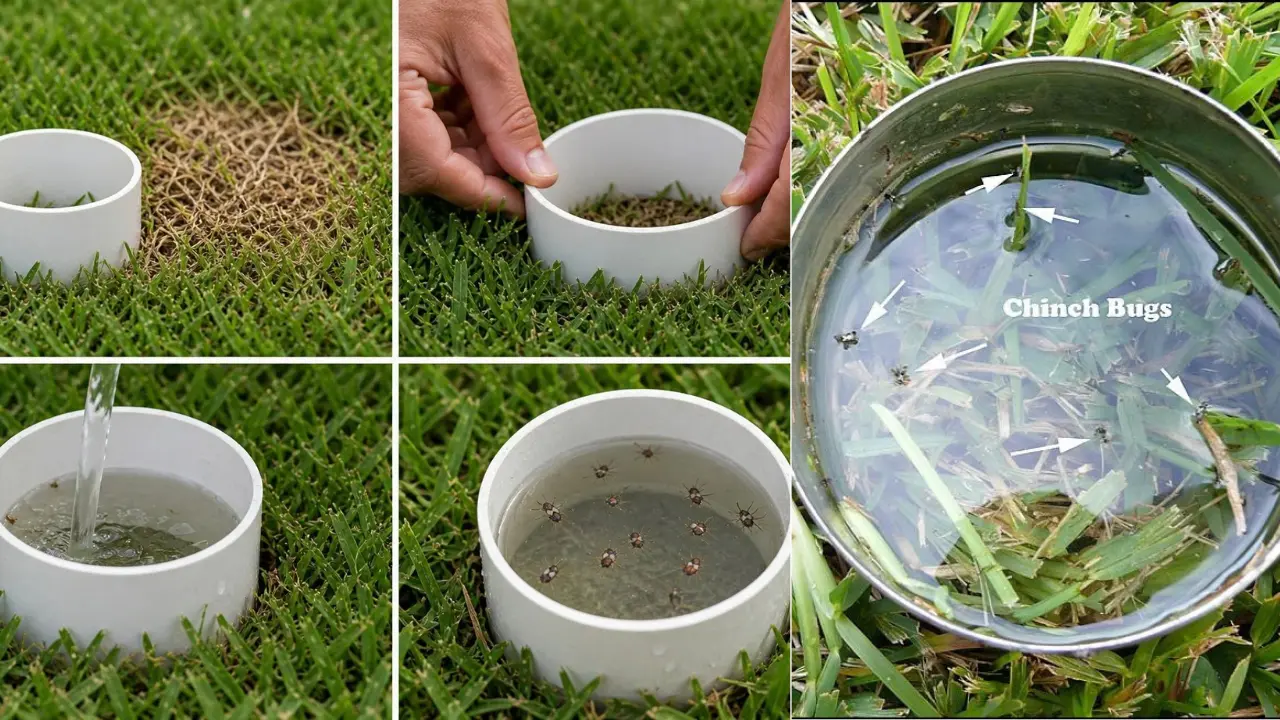
The most practical homeowner test for chinch bugs is a flotation test performed at the edge of damaged turf. Push an open-ended metal can into damaged-but-not-dead grass, fill it with water, keep the water level up for several minutes, and watch for chinch bugs floating to the surface.
Testing location matters as much as the method. A sample from the middle of completely dead grass can miss an active population that has moved outward.
Before testing: choose the right part of the lawn
Find the transition zone where green turf changes to yellow, wilted, or recently damaged grass. Texas A&M recommends checking around the edge of suspected damage because active chinch bugs feed in living turf.
A useful sample area is:
- Near an irregular expanding patch.
- In St. Augustine that is still alive but declining.
- In a sunny location if that is where the symptoms are developing.
- Close to the boundary between healthy and damaged turf.
Avoid using only the dead center of a patch.
Method 1: visual scouting
You may not need a flotation test if the insects are easy to find.
- Kneel at the active edge of the damage.
- Part the grass down to the stems and thatch.
- Watch the exposed area for moving insects.
- Look for dark adults with pale wings and orange-red or darkening nymphs.
- Repeat in several locations.
Visual scouting is fast, but it can be difficult when populations are small or the thatch is dense.
Method 2: the flotation-can test
The flotation method is widely used by university extension programs because it makes small chinch bugs easier to see.
What you need
- A metal can with both ends removed.
- Water from a hose, container, or watering can.
- A suspected area of active damage.
- Several minutes to watch the water surface.
Step-by-step
- Place the can at the transition between healthy and damaged grass.
- Push it a couple of inches into the turf and soil so water will not immediately escape.
- Fill the can with water.
- Keep adding water as needed to maintain the level.
- Watch the surface for roughly 5 to 10 minutes.
- Count and identify the insects that float up.
- Repeat the test in several spots around the damaged edge.
Extension instructions vary slightly in can size, insertion depth, and observation time. Follow the same basic principle: sample active turf, keep water in the cylinder, and repeat the test rather than depending on one location.
How many chinch bugs matter?
Texas A&M’s St. Augustinegrass management guidance gives a treatment threshold of about 25 chinch bugs per square foot. Other extension references use similar but not identical thresholds.
Because the area inside a can is smaller than a square foot, the number observed in one sample must be interpreted in relation to the can size. The previously published St. Augustine chinch bug guide explains the 6-inch-can benchmark commonly used in Texas guidance.
Thresholds are decision aids, not guarantees. Turf condition, active damage, and correct identification still matter.
Why one negative test is not enough
Chinch bugs occur in clumps rather than being evenly spread across a lawn. A can placed only a few feet away from an active concentration may return few or no insects.
If the lawn pattern strongly suggests chinch bugs but one sample is negative:
- Move along the transition zone.
- Test more than one side of the patch.
- Choose turf that is yellowing rather than completely dead.
- Try visual scouting between tests.
Repeated negative tests should make you reconsider the diagnosis rather than automatically treating.
Common chinch bug testing mistakes
Testing the dead center
The insects may have already moved to living grass.
Testing only once
Patchy insect distribution makes a single sample easy to miss.
Counting every floating insect as a chinch bug
Other insects live in turf. Identify adults and nymphs before using the count.
Ignoring irrigation coverage
Drought stress can create the same hot-spot pattern. A test should be part of a broader diagnosis.
Using the test after deciding to treat
The purpose of testing is to help decide whether chinch bugs are actually involved before treatment.
How to recognize what floats up
Adult southern chinch bugs are dark with pale wings and dark triangular markings. Early nymphs are orange-red with a pale band across the abdomen and become darker with age.
Do not confuse chinch bugs with beneficial big-eyed bugs. If identification is uncertain, review what chinch bugs look like before interpreting the count.
Can a soap drench be used instead?
Some extension programs describe detergent drench methods for turf insects, while Texas A&M commonly presents the water-filled can approach for southern chinch bugs in St. Augustine. For a Dallas-focused homeowner workflow, the plain-water flotation can is a straightforward method that avoids adding unnecessary ingredients.
What should you do with the result?
A test result should answer one question: are chinch bugs present in numbers consistent with active damage?
If you repeatedly find significant numbers at the active edge and the lawn pattern fits, the diagnosis becomes stronger. If you do not find them, investigate drought, irrigation, disease, and root problems before using an insecticide.
Testing does not replace a pesticide label
A positive test does not provide application rates, product selection, or safety instructions. If a pesticide is considered, use a product labeled for the turf site and target pest, and follow the current label.
Quick testing checklist
- Sample damaged-but-not-dead turf.
- Use the transition zone.
- Keep water in the open-ended can.
- Observe for several minutes.
- Identify insects before counting.
- Repeat in multiple spots.
- Compare the result with the lawn pattern and irrigation conditions.
Related guides
For broader context on St. Augustine damage and management, use the Dallas St. Augustine chinch bug guide.