
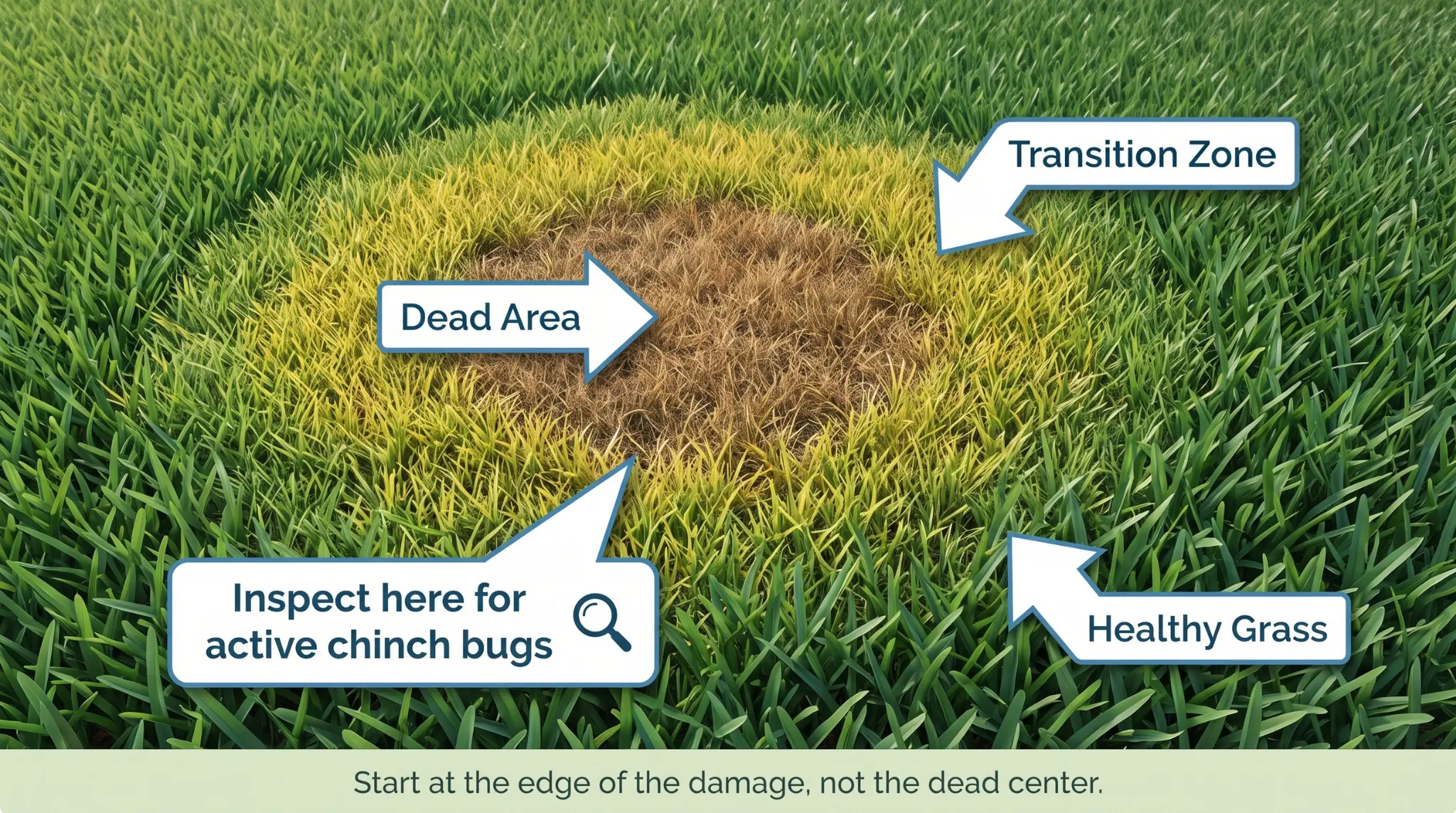
You should consider treating chinch bugs when two things line up: active lawn damage and a confirmed chinch bug population in the damaged area. Texas A&M does not recommend using the calendar alone as a reason to apply an insecticide.
Summer is an important scouting period, but treatment should be evidence-based.
Treat when damage is active and chinch bugs are present
Texas A&M Landscape IPM says treatment is usually considered when damage symptoms appear and chinch bugs are detected at the edge of the damaged area.
That means the decision should include:
- Visible yellowing or decline.
- An expanding damage pattern.
- Adults or nymphs found in the transition zone.
- A population level consistent with damage.
Do not treat just because it is July or August
Hot, dry summer weather is a common chinch bug period in Texas, but not every lawn has an infestation every summer.
A calendar-based application can waste pesticide and affect beneficial insects when no damaging population is present.
Why early detection helps
When chinch bugs are caught while the damaged area is still small, a localized treatment may be possible. Texas A&M recommends spot treatment when the infestation is restricted to isolated areas.
Waiting until a large section of turf is dead can increase the amount of lawn that needs repair even if the insects are eventually controlled.
What population level matters?
Texas A&M’s St. Augustinegrass management guidance gives roughly 25 chinch bugs per square foot as a treatment threshold. Other extension programs use similar but not identical thresholds.
Use the threshold with proper sampling and active damage rather than treating a single insect as a crisis.
When you should wait instead of treating
Pause if:
- You have not found chinch bugs.
- The brown area clearly follows a sprinkler problem.
- The turf pattern fits a disease more closely.
- Only a few insects are present with no active damage.
- The product label does not allow the intended use.
Correct diagnosis can prevent unnecessary pesticide use.
Should you treat before damage appears?
Routine preventive insecticide use is not the standard Texas A&M approach for chinch bugs. The emphasis is on scouting and monitoring so a damaging population can be detected before severe injury develops.
In lawns with a history of chinch bugs, inspect known trouble spots regularly during the warm season rather than automatically treating them.
What time of year should Dallas homeowners scout?
Texas A&M identifies hot, dry conditions—especially July and August—as a common problem period. The St. Augustine maintenance calendar also calls for chinch bug scouting during the warm growing season.
That is a scouting window, not a fixed treatment date.
What if the lawn is already mostly dead?
Confirm whether chinch bugs are still active at the living edge before treating. Applying insecticide to completely dead turf does not restore it.
If the population has moved on or the current problem has a different cause, repair decisions may matter more than another application.
What if you treated recently?
Do not reapply automatically. Follow the label’s minimum interval and maximum-use directions. Texas A&M recommends checking the site every 3 to 5 days for at least two weeks after treatment to determine whether the infestation is under control.
The separate chinch bug treatment guide covers label and post-treatment considerations.
Decision checklist
Before treating, answer yes to these questions:
- Is the grass actively declining?
- Does the pattern fit chinch bug injury?
- Have chinch bugs been identified correctly?
- Are they present around the active edge?
- Does the population justify treatment?
- Is the chosen product labeled for the turf site and pest?
Key takeaway
The right time to treat is when evidence supports treatment—not when the calendar says chinch bug season has arrived.
Timing within the day is label-dependent
Do not assume that early morning, midday, or evening is universally best. Weather limits, irrigation instructions, and application conditions vary by product. Follow the label rather than a generic time-of-day rule.
What about treating before a rain?
Rain can move or dilute some applications, while certain formulations require irrigation to activate them. Because those directions differ, check the forecast and the label together. Do not rely on rain as a substitute for label-directed watering.
When not to rush
If symptoms are mild and the diagnosis is uncertain, spending another day confirming the pest is usually better than treating the wrong problem. Chinch bug injury can progress quickly during hot weather, but unnecessary pesticide use also has costs.
When earlier action matters
Once a damaging population is confirmed at an expanding edge, delaying until the center of the patch is completely dead can increase the amount of turf that needs repair. The goal is timely, evidence-based action—not automatic calendar spraying.