
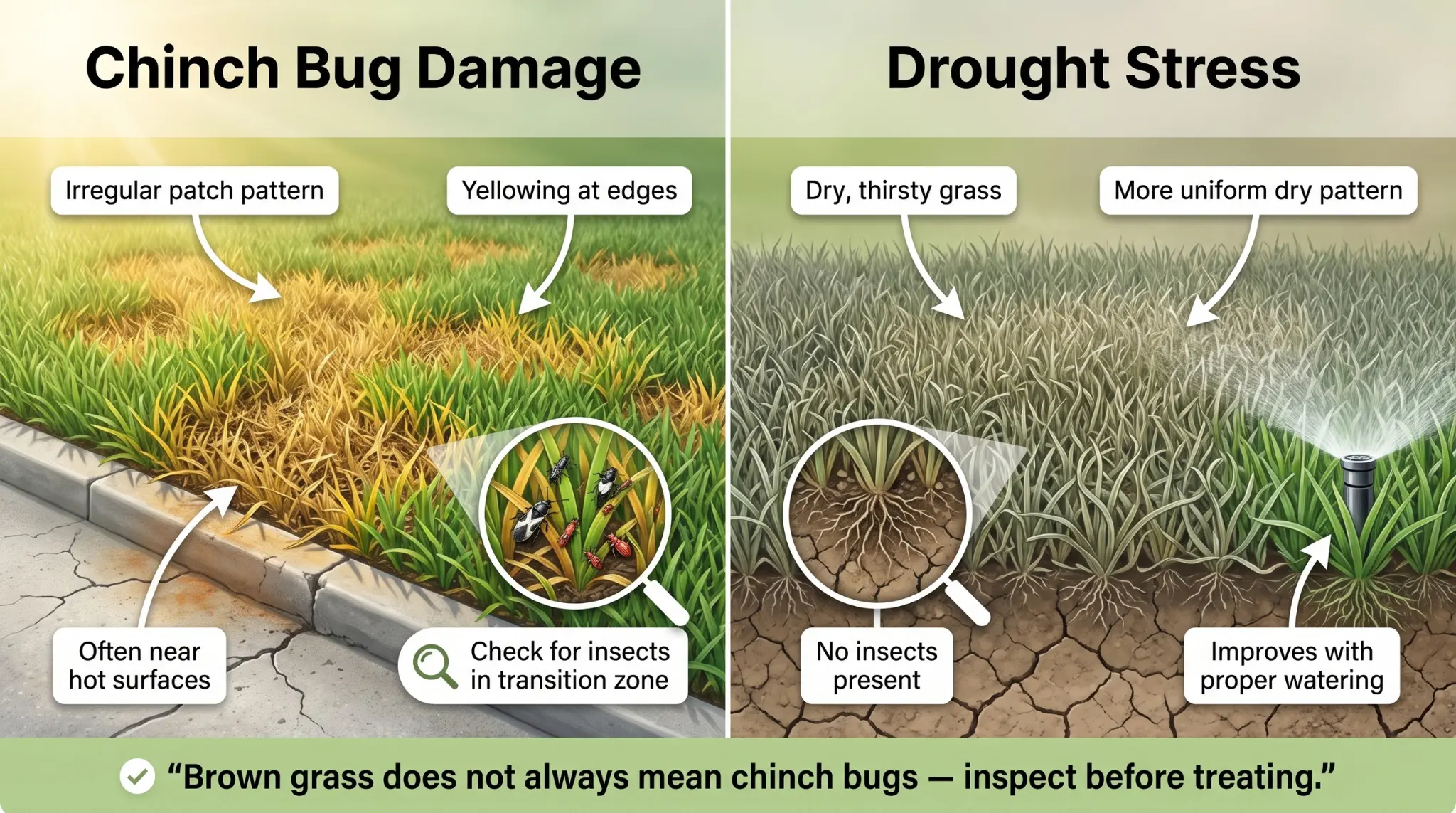
Chinch bug damage is more likely when irregular yellow-brown patches develop in hot, sunny St. Augustine and the insects are found at the active edge. Lawn fungus is more likely when symptoms match a known turf disease pattern, season, and plant tissue signs.
Because both can produce brown turf, the right diagnosis depends on more than patch color.
Start with season and weather
Texas A&M associates southern chinch bug problems with hot, dry weather. Large patch, by contrast, is a warm-season turf disease most associated with cooler, moist periods in spring and fall.
Take-all root rot can be seen at different times when turf is stressed but is often prominent as St. Augustine comes out of dormancy in spring and early summer.
Season does not prove the cause, but it can help narrow the list.
Compare the patch shape
Chinch bug damage is commonly irregular because the insects occur in clumps and move through living turf.
Large patch often produces circular or semicircular areas. Texas A&M notes that leaf tissue at the edge can yellow before the patch turns brown.
Take-all root rot can also create irregular patches, so root condition becomes more important for that comparison.
Look closely at the grass blades and stolons
With large patch, affected leaf blades may separate easily from the stolon near the diseased area. Chinch bugs do not create that same classic leaf-separation sign.
Chinch bug diagnosis instead depends on finding the insects around stems, stolons, and thatch at the active edge.
Check the roots
Take-all root rot is a root disease. Texas A&M describes infected roots as short, dark, and rotten, and affected stolons can be easier to lift from the soil.
If roots are visibly compromised, a root disease deserves more attention than a surface-feeding insect explanation.
Inspect for actual chinch bugs
At the border of an irregular hot-weather patch, part the grass and look for:
- Dark adults with pale wings.
- Orange-red or darkening nymphs.
- Multiple insects in damaged-but-not-dead turf.
If you cannot find chinch bugs after checking several appropriate locations, do not assume insects simply because the lawn is brown.
Large patch vs. chinch bugs
| Clue | Chinch bugs | Large patch |
|---|---|---|
| Typical weather association | Hot, dry conditions | Cooler, moist conditions |
| Pattern | Irregular, expanding | Often circular or semicircular |
| Key evidence | Insects at active edge | Disease symptoms in leaf tissue / patch pattern |
| Best next step | Scout or flotation test | Inspect tissue and compare with disease guidance |
Take-all root rot vs. chinch bugs
| Clue | Chinch bugs | Take-all root rot |
|---|---|---|
| Main feeding/injury zone | Stems, stolons, thatch | Roots |
| Root condition | Not the defining sign | Short, dark, rotten roots can occur |
| Direct evidence | Chinch bugs present | Root disease symptoms |
Can both insects and disease occur together?
Yes. Stressed turf can face more than one problem. Finding one issue does not prove that it explains every patch in the yard.
Evaluate each damaged area by its pattern, plant symptoms, moisture conditions, and pest evidence.
Why treatment without diagnosis is a problem
An insecticide will not correct fungal disease, and a fungicide will not control chinch bugs. Using the wrong treatment can waste money, delay the correct response, and affect beneficial organisms.
Texas A&M turf guidance emphasizes proper identification before management decisions.
When a lab diagnosis can help
If symptoms remain unclear, a turf sample evaluated by a plant diagnostic service can be useful for suspected disease. A good sample should include living and affected tissue rather than only completely dead grass.
For suspected chinch bugs, direct field inspection and flotation testing are usually the first homeowner steps.
A practical comparison workflow
- Note the season and recent weather.
- Map the patch shape.
- Inspect the leaf tissue and stolons.
- Check root health.
- Scout the active edge for chinch bugs.
- Use a flotation test if needed.
- Avoid pesticide treatment until the evidence supports a specific cause.
Related guides
For insect confirmation, use how to tell if a lawn has chinch bugs. For drought comparison, read chinch bugs vs. drought.
Leaf symptoms can matter as much as the patch shape
From a distance, many turf problems look like brown circles or irregular patches. Up close, disease can produce clues on leaves, stolons, or roots that an insect problem does not. Look at the plant tissue itself rather than relying only on the outline of the damaged area.
Do not use a fungicide “just in case”
Just as an insecticide should not be used without confirming a pest, a fungicide should not be applied merely because the lawn is brown. Different turf diseases respond to different products and timing, and some symptoms are caused by non-disease stresses.
When a sample can be more useful than another treatment
If the lawn has mixed symptoms—such as irregular browning plus root decline—or if several treatments have failed, a diagnostic sample can be more valuable than guessing. Include the boundary between healthy and affected turf, not only dead material, because active symptoms are easier to evaluate there.
Remember that multiple problems can overlap
A drought-stressed St. Augustine lawn can also develop disease or support chinch bug injury. Finding one cause does not guarantee it is the only cause. Treat the lawn as a system and revisit the diagnosis when the response does not match expectations.