
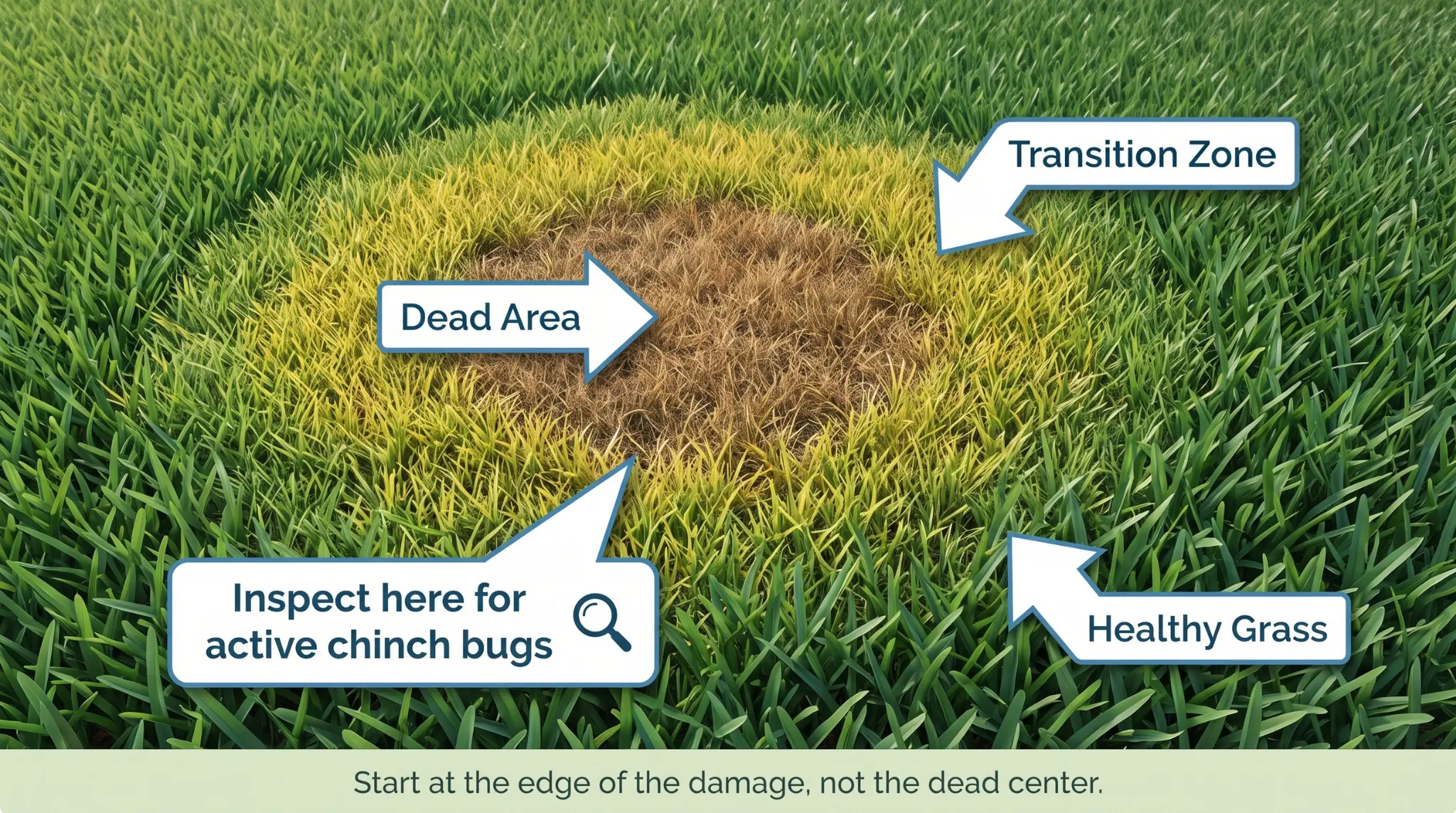
You can tell whether a lawn is likely to have chinch bugs by combining the damage pattern with direct evidence of the insects. Look for irregular expanding yellow or brown areas, inspect the border between healthy and damaged turf, and confirm adults or nymphs in the stems and thatch. If needed, use a flotation test.
Do not rely on brown grass alone. Drought, poor sprinkler coverage, disease, and root damage can look similar.
Step 1: Check whether the damage pattern fits
Texas A&M describes chinch bug injury in St. Augustine as irregular patches of dying turf that can enlarge and merge. The grass may yellow before turning brown.
Clues that justify a closer chinch bug inspection include:
- Irregular rather than perfectly circular damage.
- A yellow or declining edge around dead turf.
- Damage spreading into previously healthy grass.
- Problems concentrated in sunny, hot sections.
- St. Augustine near sidewalks, driveways, or curbs.
These clues raise suspicion; they do not confirm the pest.
Step 2: Look at the transition zone
The transition zone is the edge where healthy green grass changes to yellow, wilted, or recently damaged turf. This is often the best place to find active chinch bugs.
Part the grass and inspect:
- Lower stems.
- Grass crowns.
- Thatch.
- The upper soil surface.
Adult southern chinch bugs are tiny and dark with pale wings. Young nymphs may be orange-red with a light band across the abdomen.
Step 3: Check more than one location
Chinch bugs are not evenly distributed through a lawn. One negative inspection does not necessarily rule them out, and one insect does not necessarily explain an entire brown area.
Check several points around the active edge. This gives you a better picture of whether a population is concentrated in the damaged area.
Step 4: Rule out an obvious irrigation problem
Hot, sunny turf near pavement is also where irrigation problems can become obvious. Before assuming insects, run the sprinkler system and check whether the damaged area is actually receiving comparable coverage.
Look for:
- Blocked or tilted sprinkler heads.
- Poor overlap between zones.
- Water landing on pavement instead of turf.
- Dry soil in the damaged area.
- A pattern that closely follows sprinkler gaps.
If the problem lines up with irrigation coverage and you cannot find chinch bugs, water stress deserves more attention.
Step 5: Use a flotation test if visual inspection is uncertain
A flotation test uses an open-ended can pushed into the turf and filled with water. Chinch bugs rise to the surface, making them easier to count and identify.
Texas A&M recommends placing the test in suspected turf near the damaged edge rather than in the middle of a completely dead patch.
For exact steps, see the dedicated guide to testing a lawn for chinch bugs when it is live.
What counts as stronger evidence?
The strongest homeowner diagnosis usually has several pieces that agree:
- The turf is St. Augustine or another susceptible grass.
- The damage pattern is compatible with chinch bug injury.
- The insects match chinch bug identification features.
- Adults or nymphs are repeatedly found near active damage.
- Obvious alternatives such as sprinkler failure do not explain the pattern better.
This is more reliable than using any one clue by itself.
Signs that point away from chinch bugs
Question the diagnosis if:
- The damage is strongly circular and develops mainly in cool, moist weather.
- The turf lifts easily because roots are badly damaged.
- The pattern exactly follows a dry sprinkler zone.
- The soil is extremely dry and no insects are found after repeated checks.
- The lawn is declining mainly in deep shade.
These findings do not identify the alternative problem by themselves, but they are reasons to widen the investigation.
Chinch bugs vs. large patch
Texas A&M describes large patch as a warm-season turf disease that is most common in cooler spring and fall conditions. It often produces circular or semicircular patches, while chinch bug injury is more often irregular and associated with hot-weather activity.
If leaf blades at the edge of a patch separate easily from the stolons, disease may deserve a closer look.
Chinch bugs vs. take-all root rot
Take-all root rot can produce yellowing and irregular brown patches, but the disease damages the root system. Texas A&M notes that affected roots can become short, dark, and rotten, making stolons easier to lift.
That root symptom is different from simply finding chinch bugs feeding around stems and thatch.
Chinch bugs vs. grubs
White grubs feed below the surface and can damage roots. If turf rolls or lifts back because roots are missing, inspect the soil for grubs rather than assuming a surface-feeding chinch bug problem.
Can watering confirm chinch bugs?
No. A lawn that remains brown after watering is not automatically infested. Water response is only one clue because dead turf, root disease, compacted soil, and irrigation distribution can all affect recovery.
Use water as part of the diagnosis, not as the final test.
Do you need to see the insects before treating?
That is the safest standard. Texas A&M’s management guidance recommends considering treatment when damage symptoms are present and chinch bugs are detected at the damaged edge.
Applying an insecticide without confirming the pest can kill beneficial insects and does nothing to correct drought, disease, or irrigation problems.
Dallas homeowner checklist
For a Dallas-area St. Augustine lawn, work through these questions:
- Is the problem active during hot weather?
- Is the damaged area sunny?
- Does it sit near pavement or another heat-reflecting surface?
- Is the patch irregular and expanding?
- Is there yellowing at the active edge?
- Is sprinkler coverage reasonable?
- Can you find adults or nymphs in the transition zone?
The local climate makes chinch bugs worth checking, but it does not replace direct inspection.
What to read next
Use what chinch bugs look like if insect identification is the main uncertainty. Use the damage guide for visual lawn symptoms, and the St. Augustine pillar guide for the complete diagnostic picture.