
Chinch bug nymphs are the immature, wingless stages of the insect. Early southern chinch bug nymphs are orange-red or pinkish with a pale band across the abdomen, then become darker as they grow and develop wing pads.
That changing appearance is important. A homeowner who expects every chinch bug to be black and white may overlook the younger stages that are actively feeding in the lawn.
Nymphs are not larvae
Chinch bugs develop by gradual metamorphosis. Their life cycle is egg → nymph → adult. They do not have a grub-like larval stage or a pupa.
The nymphs resemble small, wingless versions of the adult body shape, but their colors and markings change with each molt.
What the youngest nymphs look like
Texas A&M describes early southern chinch bug nymphs as orange-pink with a whitish band across the abdomen just behind the thorax.
Useful field clues include:
- Very small size.
- Bright orange, red, or pinkish coloration.
- A pale band across the middle of the body.
- No fully developed wings.
- Fast movement around grass stems and thatch.
How their appearance changes as they mature
As a nymph molts through later stages, the body darkens. Orange-red color gives way to darker brown, gray, or nearly black tones, and small wing pads become visible.
By the final nymph stages, the insect can look much more like a small adult except that it does not yet have the fully developed pale wings.
| Stage | Typical appearance | Wing development |
|---|---|---|
| Early nymph | Orange-red or pinkish with pale abdominal band | No developed wings |
| Middle nymph | Darker orange-brown | Small wing pads begin |
| Late nymph | Dark brown to nearly black | Wing pads obvious |
| Adult | Dark body with pale wings and dark markings | Fully developed or short adult wings |
How large are chinch bug nymphs?
They are tiny. Texas A&M lists southern chinch bug nymphs from roughly 1/16 inch up to near adult size. Their small size makes them difficult to identify without close inspection.
A hand lens or a close-up phone photo can help, but color, wing development, and lawn location should all be considered together.
Where to find nymphs in the lawn
Nymphs are usually found low in the turf, around stems, stolons, crowns, and thatch. If a lawn has active damage, inspect the border where green turf changes to yellowing grass.
That transition zone often contains a mix of feeding stages, especially during warm weather.
Why nymphs matter in diagnosis
Finding multiple nymphs in an active damage zone is useful evidence because it indicates an established, reproducing population rather than a single wandering adult.
Still, their presence should be evaluated with the lawn pattern and population level. One tiny insect does not prove that all brown grass was caused by chinch bugs.
Chinch bug nymph vs. adult
The easiest differences are wings and color. Adults have the characteristic pale wings over a dark body. Nymphs lack full wings and begin much brighter.
For a broader comparison of all stages, see what chinch bugs look like.
Chinch bug nymph vs. big-eyed bug
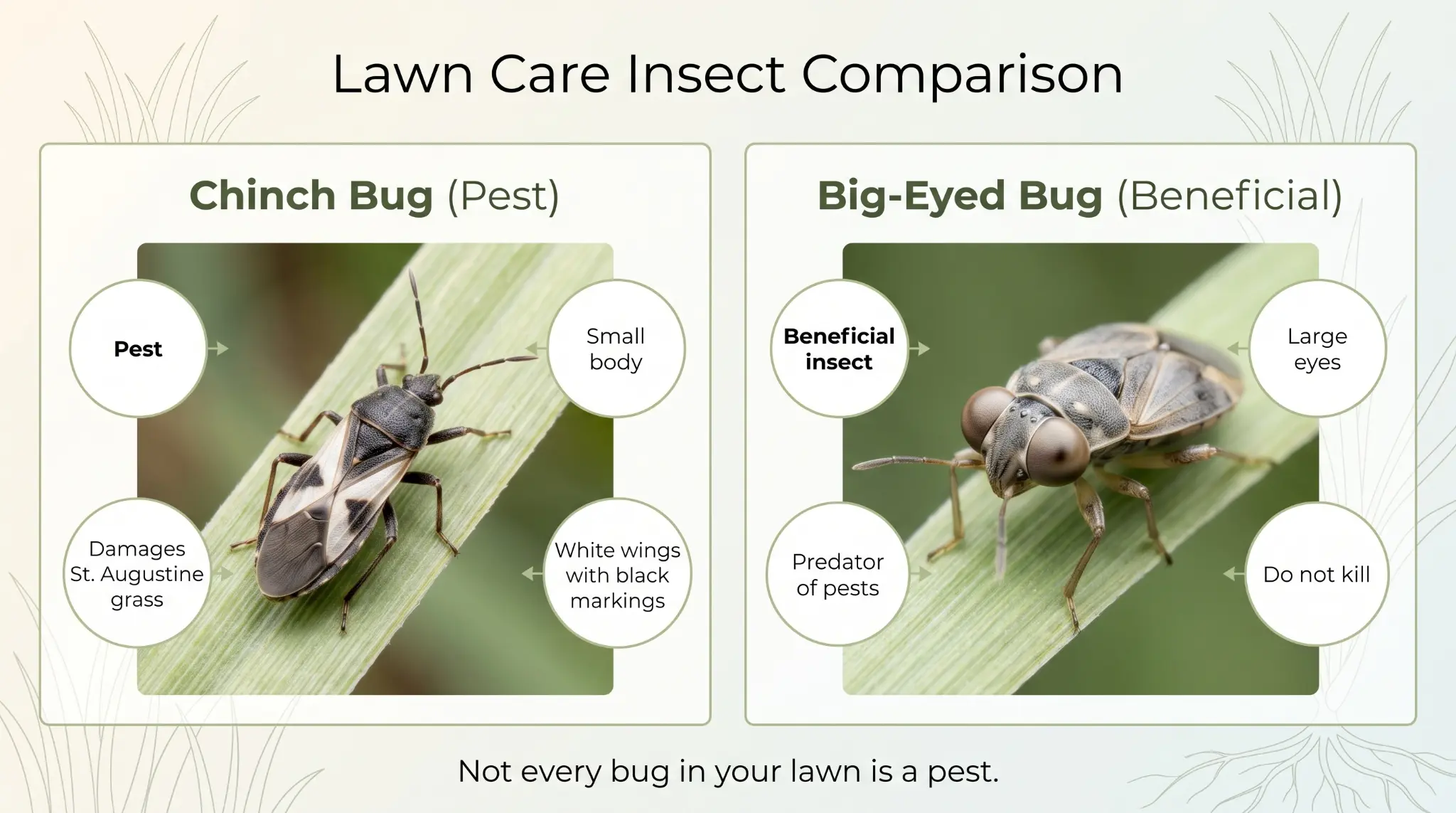
Big-eyed bugs are beneficial predators that can live in the same turf. Their large eyes and broad head help distinguish them from chinch bugs.
Young chinch bugs are easier to recognize when the orange-red color and pale abdominal band are clear, but later dark nymphs can be harder to separate from other small insects. If identification is uncertain, do not treat based only on size.
Can you see nymphs during a flotation test?
Yes. A flotation test can bring both nymphs and adults to the water surface. Because nymphs are small, this method can make them easier to spot than visual scouting alone.
Use the chinch bug testing guide for the step-by-step method.
What does finding many nymphs mean?
A concentration of nymphs near actively declining turf can support the diagnosis that chinch bugs are reproducing and feeding in that area. Extension programs use population thresholds as part of treatment decisions rather than recommending treatment simply because a few insects are present.
The relevant threshold depends on the sampling method and source, so use established extension guidance and the current pesticide label rather than creating your own cutoff.
Key takeaway
Early chinch bug nymphs are tiny, orange-red or pinkish insects with a pale band across the abdomen. They darken with each molt and develop wing pads before becoming dark adults with pale wings.
If the lawn is showing damage, combine nymph identification with the broader diagnostic checklist for chinch bugs rather than treating from appearance alone.
Common nymph-identification mistakes
The biggest mistake is treating any tiny reddish insect as a chinch bug. Color is useful, but it should be combined with body shape, the pale abdominal band on younger nymphs, the absence of full wings, and the insect’s location in turf.
Another mistake is assuming every life stage looks alike. A late nymph may be much darker than an early nymph, and a homeowner can easily think two different species are present when the insects are simply at different stages.
What to photograph if you need a second opinion
Take one close photo of the insect, one wider photo showing where it was found in the grass, and one photo of the damage pattern. Including a coin or ruler for scale can help. A useful identification record connects the insect with the lawn context rather than showing an isolated blurry speck.
Why nymphs are useful for early detection
Adults may move through a lawn, but finding several nymphs at the active damage edge suggests the population is reproducing in the turf. That makes nymph identification especially useful when a homeowner is trying to catch a problem before a large area dies.