
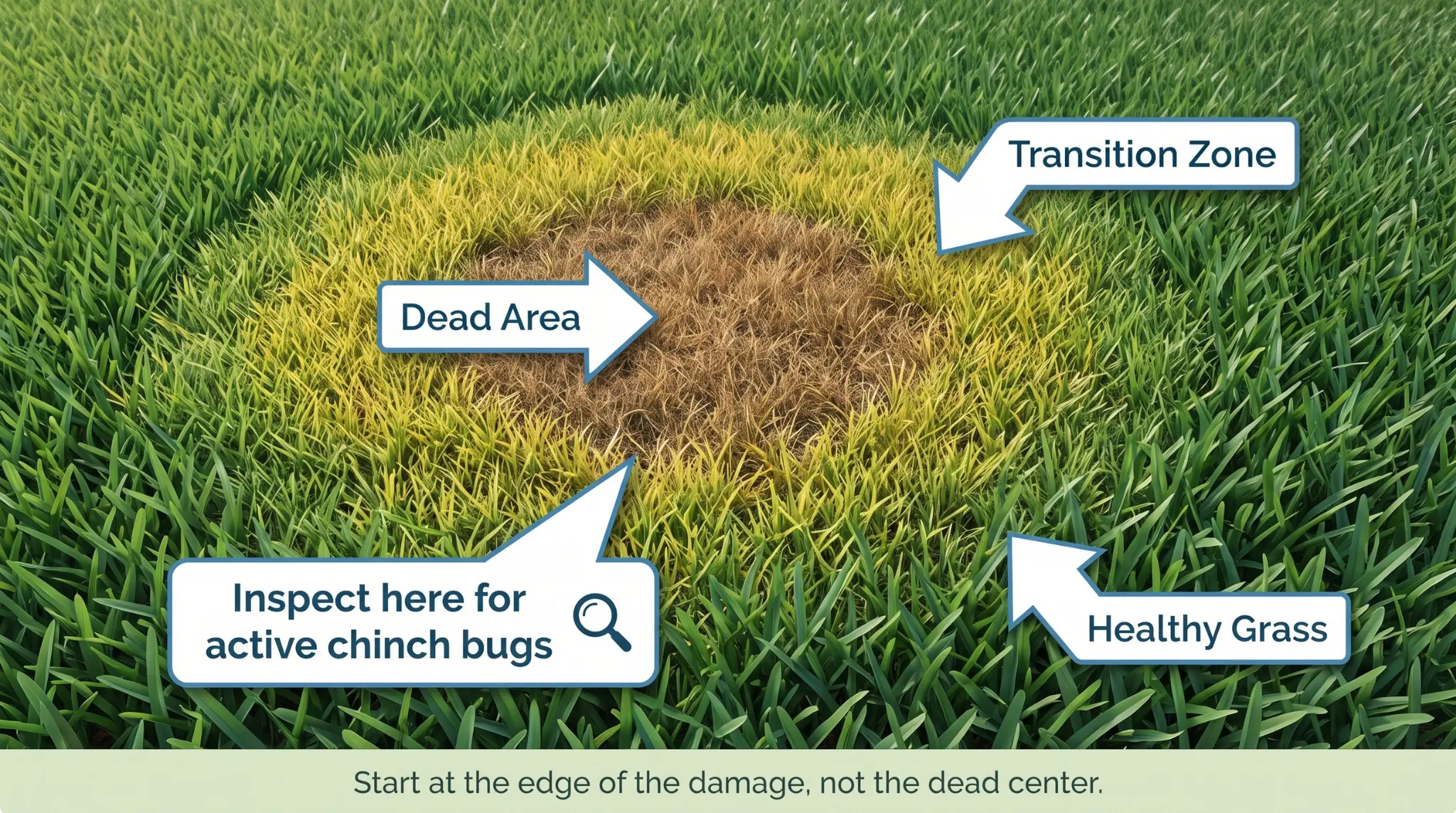
Chinch bugs live low in the lawn, around grass stems, crowns, stolons, thatch, and the upper organic layer near the soil surface. In a damaged lawn, the best place to look is usually the transition zone where healthy grass meets yellowing or recently injured turf.
Knowing where they live helps homeowners inspect the right place instead of searching the middle of a dead patch.
Chinch bugs spend most of their time near the base of grass
Southern chinch bugs feed on plant fluids from St. Augustine stems and stolons. University extension resources consistently place the insects in the lower turf canopy and thatch rather than high on the leaf blades.
They may crawl upward when disturbed or when populations are high, but the feeding zone is typically close to the base of the plant.
The thatch layer is important habitat
Thatch is the layer of partially decomposed stems and organic material between green leaves and the soil surface. It can provide protected space for chinch bugs to move and feed.
Texas A&M and NC State both emphasize that good turf management and avoiding excessive thatch can reduce conditions that favor chinch bug problems.
Why the edge of damage is the best place to inspect
When chinch bugs kill a section of grass, the insects need living turf to continue feeding. Active bugs therefore tend to be found near the boundary between damaged and healthy grass.
Inspect:
- Yellowing turf at the outer edge of a patch.
- Grass that still has living green tissue.
- The lower stems and thatch immediately beside dead turf.
- Several points around the patch rather than one location.
The dead center may contain few active insects by the time the damage is obvious.
Sunny and hot lawn areas deserve extra attention
Texas A&M describes southern chinch bug problems as especially important during hot, dry conditions. Damage commonly develops in sunny St. Augustine.
That means the lawn beside:
- Driveways
- Sidewalks
- Curbs
- Patios
- Other heat-reflecting surfaces
can be practical places to scout first when symptoms fit.
However, these same areas can also suffer from drought and poor sprinkler coverage, so location is a clue rather than proof.
Do chinch bugs live in soil?
They are primarily turf-surface insects rather than deep soil pests. Research and extension descriptions place southern chinch bugs from the thatch into the upper organic soil layer, with much of the feeding activity close to grass stems and stolons.
This differs from white grubs, which are found deeper around roots and can cause turf to lose root anchorage.
Do chinch bugs live in dead grass?
They may be present in thatch and debris, but active feeding requires living plant tissue. Once a patch is completely dead, many bugs may move toward adjacent live turf.
That is why a homeowner should inspect the living edge rather than rely on the center of the brownest area.
Where do they spend the colder season?
Texas A&M notes that winter is spent in the adult stage except where conditions permit continued reproduction. Other extension sources describe overwintering adults using protected areas in or near turf and landscape debris.
For Dallas homeowners, the practical point is not to search randomly in winter but to monitor susceptible St. Augustine as warm conditions return and during the hot-weather period when damage is easier to detect.
How their location changes as damage spreads
Chinch bugs often occur in clumps. As one section of turf declines, feeding groups can move into neighboring living grass. The visible patch can then enlarge.
This movement helps explain why repeated sampling around an active edge is more useful than one test from one fixed point.
Where to place a flotation can
If visual inspection does not reveal the insects, place an open-ended can in damaged-but-not-dead turf at the active edge.
The chinch bug flotation-test guide explains the sampling process. Avoid choosing only a completely dead center where bugs may no longer be concentrated.
Where not to assume chinch bugs are hiding
A brown area is not automatically chinch bug habitat. If the lawn problem is in deep shade, follows an obvious sprinkler gap, develops in cool wet weather, or involves root loss, another cause may fit better.
Use the full chinch bug diagnostic checklist before deciding what the location means.
Quick scouting map
When inspecting St. Augustine, prioritize locations in this order:
- The outer edge of an irregular yellow-brown patch.
- Sunny turf next to pavement.
- Lower stems and crowns.
- Thatch immediately above the soil.
- Several nearby points to account for clumped populations.
Key takeaway
Chinch bugs live and feed low in the turf. The most useful place to find them is typically where living St. Augustine transitions into damaged grass—not the middle of a dead patch.
For identification features, see what chinch bugs look like. For Dallas-specific St. Augustine context, use the main chinch bug guide.